
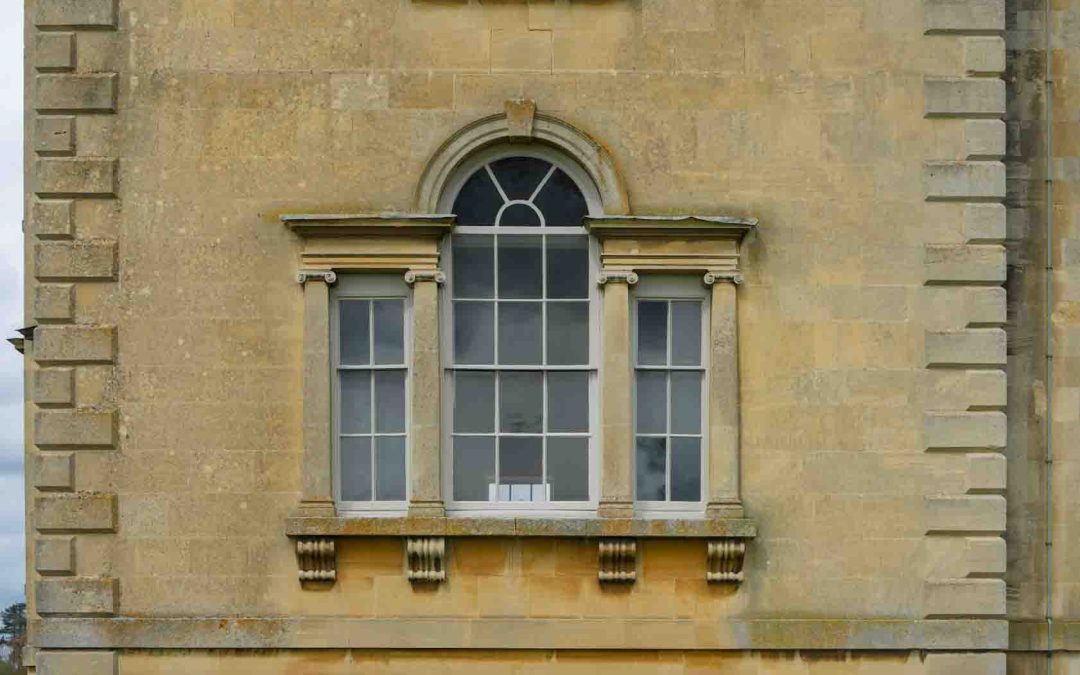
Featured Image: Serliana or Venetian Window at Croome, Worcestershire
Few architectural forms have proved so durable, so geographically wide-ranging, or so consistently associated with intellectual aspiration and refined taste as the Venetian window. Composed of a central arched opening flanked by two narrower rectangular lights, separated by pilasters or columns, the form appears with striking consistency across three centuries and two continents. Yet its very ubiquity has obscured its origins and blurred its nomenclature. Was it Venetian, Palladian, or something else entirely?
Origins and Nomenclature
The form now commonly called the Venetian window, the Palladian window, or the Serliana was first codified by the Bolognese architect Sebastiano Serlio (1475–1554) in the fourth book of his Tutte l’opere d’architettura et prospetiva, published in Venice in 1537.1 For this reason, the most historically accurate designation is the Serliana, though the term ‘Venetian window’ became current in Britain during the eighteenth century, and ‘Palladian window’ entered common use both because Andrea Palladio deployed the motif with particular brilliance and because of its strong association with the Palladian revival in England.
Serlio’s codification did not constitute an invention: the motif had already appeared in Bramante’s work in the early sixteenth century. Its essential logic—the reconciliation of a wide opening with a structural arch above, the arch supported by columns or pilasters that in turn define the flanking rectangular lights—addressed both structural and aesthetic imperatives. The alternation of curved and straight, wide and narrow, gives the composition its characteristic sense of triumphal weight and elegance.
The Basilica Palladiana, Vicenza (from 1549)

Basilica Palladiana: (Palazzo della Ragione) Vincenza
If Serlio gave the form its theoretical identity, it was Andrea Palladio (1508–1580) who brought it its greatest architectural expression. In 1546, Palladio was commissioned to redesign the medieval Palazzo della Ragione in Vicenza, which had suffered a partial collapse of an earlier loggia. The solution he devised was bold: to wrap the existing Gothic building with two superimposed loggias employing the Serliana motif at every bay, using the structural pier as the dividing element between the arched central opening and its rectangular companions.2 Work commenced in April 1549; the lower loggia was substantially complete by the time of Palladio’s death in 1580, and the upper was finished by 1614. The result – subsequently named the Basilica Palladiana, though it was never a church – became one of the most celebrated architectural tours de force of the Renaissance.
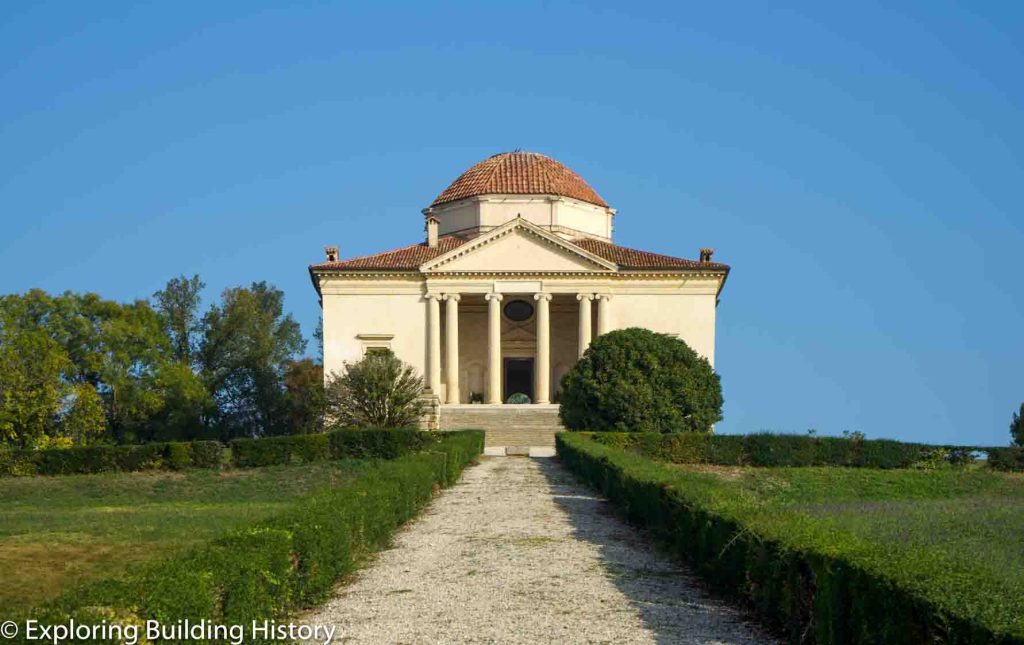
Villa Rocco Pisana (c. 1575-78)
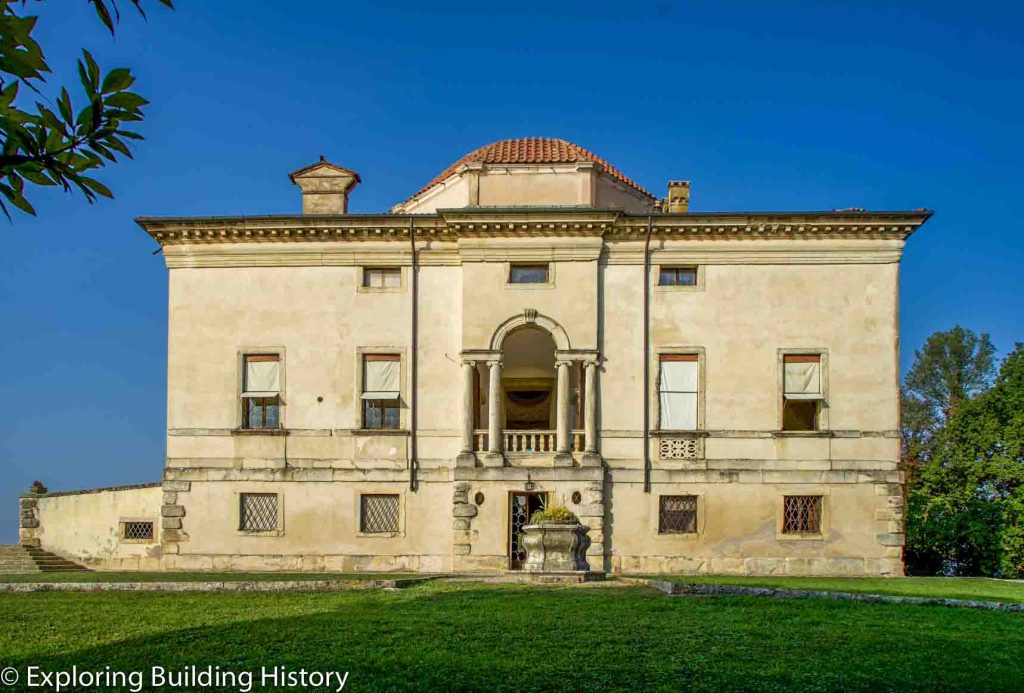
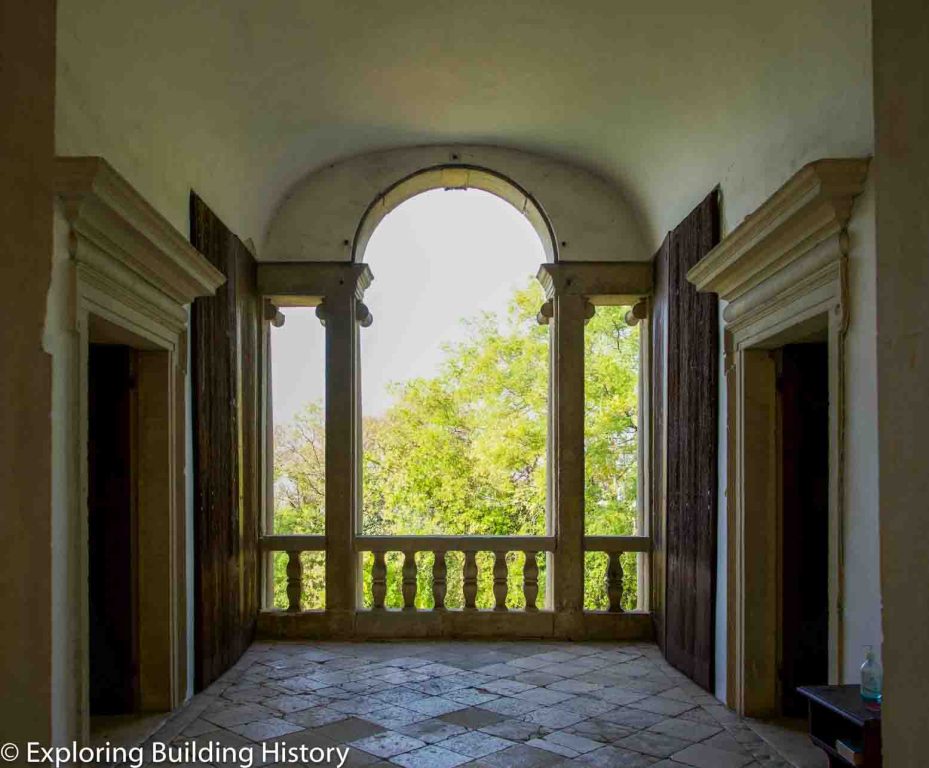
Palladio deployed the window form to a certain extent in his villa designs throughout the Veneto in the 1550s and 1560s. A more dedicated use of the motif is found at Villa Rocca Pisana at Lonigo, Province of Vicenza (c. 1575–78), designed not by Palladio himself but by his younger contemporary Vincenzo Scamozzi (1548–1616) for the Venetian nobleman Vettor Pisani. At piano nobile level, three of the villa’s four façades carry a Serliana flanked by Ionic semi-columns, which floods light into the corridors behind and functions as a kind of elevated loggia.3 In 1570 Palladio published I quattro libri dell’architettura (The Four Books of Architecture), disseminating his principles across Europe and establishing the Serliana as one of the definitive motifs of classical architecture.4
Rome: Piazza Navona (1644–53)
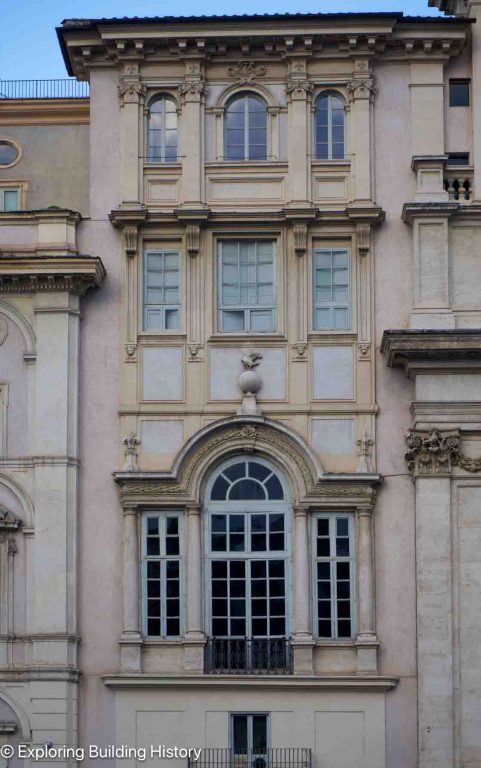
Serliana or Venetian Window in Piazza Navona, Rome
The Serliana was not exclusively a Venetian or Palladian possession. On the Piazza Navona in Rome, the palace built for the Pamphilj family between 1644 and 1650 to designs by Girolamo Rainaldi, with later intervention by Francesco Borromini (from 1647), stands adjacent to the church of Sant’Agnese in Agone, remodelled by Borromini from 1653.5The section of building between the two structures – whether strictly part of the palace or the church’s domestic range – displays a Venetian window of conspicuous elegance. This Roman example is a reminder that the motif, for all its Venetian and later English associations, remained a living element of the Baroque vocabulary well into the seventeenth century.
The English Palladian Revival
The conduit for the Venetian window’s entry into England was Inigo Jones (1573–1652), who encountered Palladio’s buildings during extensive travels in Italy culminating around 1613–14, and who returned with a copy of the Quattro Libri annotated in his own hand (now preserved in Worcester College, Oxford).6 Yet the full flowering of the form in English architecture had to await the Palladian revival of the early eighteenth century, a movement self-consciously positioned as a reaction against English Baroque excess.

Chiswick House: Completed 1729
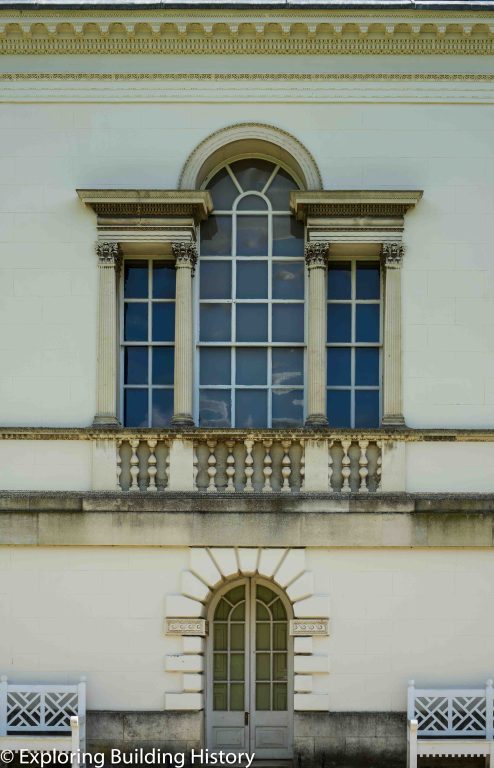
Chiswick House, South Side, Serliana or Venetian Window
The movement’s theoretical foundation was laid by Colen Campbell’s Vitruvius Britannicus (three volumes, 1715, 1717, and 1725), which presented neo-Palladian designs alongside surveys of existing English buildings, implicitly constructing a canon of taste.7 Its presiding genius was Richard Boyle, third Earl of Burlington (1694–1753), whose villa at Chiswick (1726–29) was directly inspired by Palladio’s Villa Rotonda.8 Burlington and his collaborator William Kent pursued an ideal of rational, measured beauty in which the Venetian window served as both structural solution and emblem of intellectual pedigree.
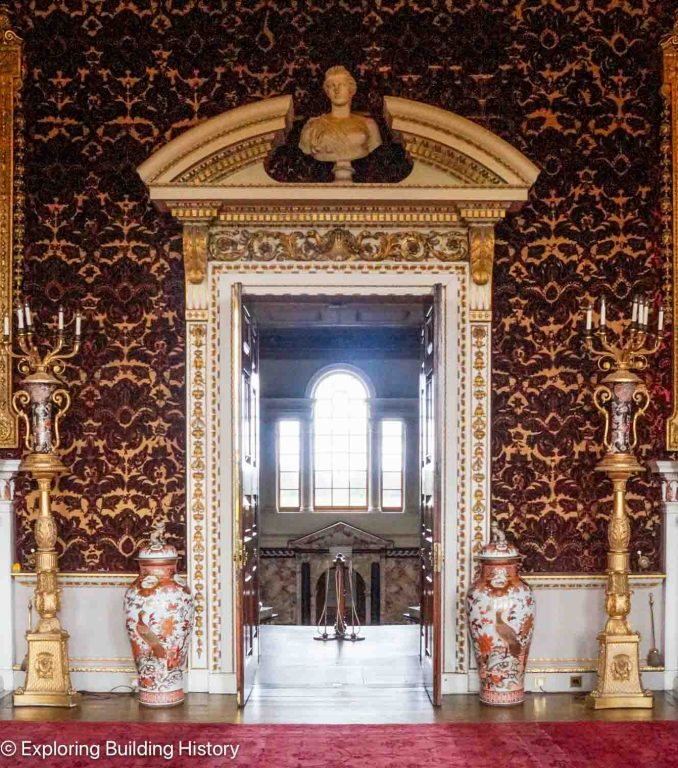
Holkham Hall Look through to the Serliana or Venetian Window of the Marble Hall
Holkham Hall in Norfolk, begun in 1734 to designs by William Kent for Thomas Coke, first Earl of Leicester, and completed only in 1764, is among the grandest expressions of this vision.9 Kent deployed the Venetian window throughout the principal interiors and on the entrance facade of the great Palladian pile, making it one of the defining architectural statements of Georgian England.
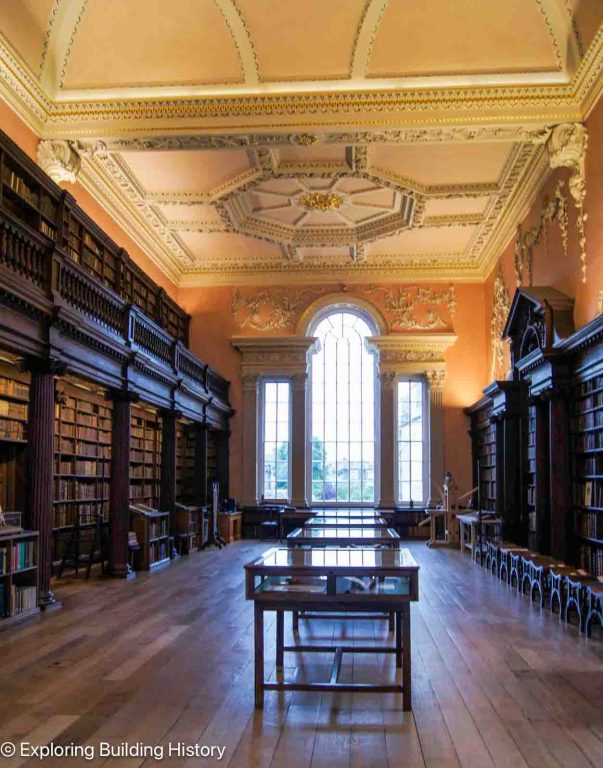
Serliana or Venetian Window at Christ Church College Library, Oxford
Oxford preserves a distinguished collegiate example in the library building completing the Peckwater Quadrangle at Christ Church. The quadrangle itself was designed by the architectural amateur Henry Aldrich, built 1706–11; the library, attributed to Dr George Clarke of All Souls, was begun in 1717 and not completed until 1772, giving it the distinction of one of the longest-constructed buildings of the Palladian revival.10 Its Venetian windows announce scholarly purpose with appropriate gravity.
The Vernacular Reach of the Venetian Window
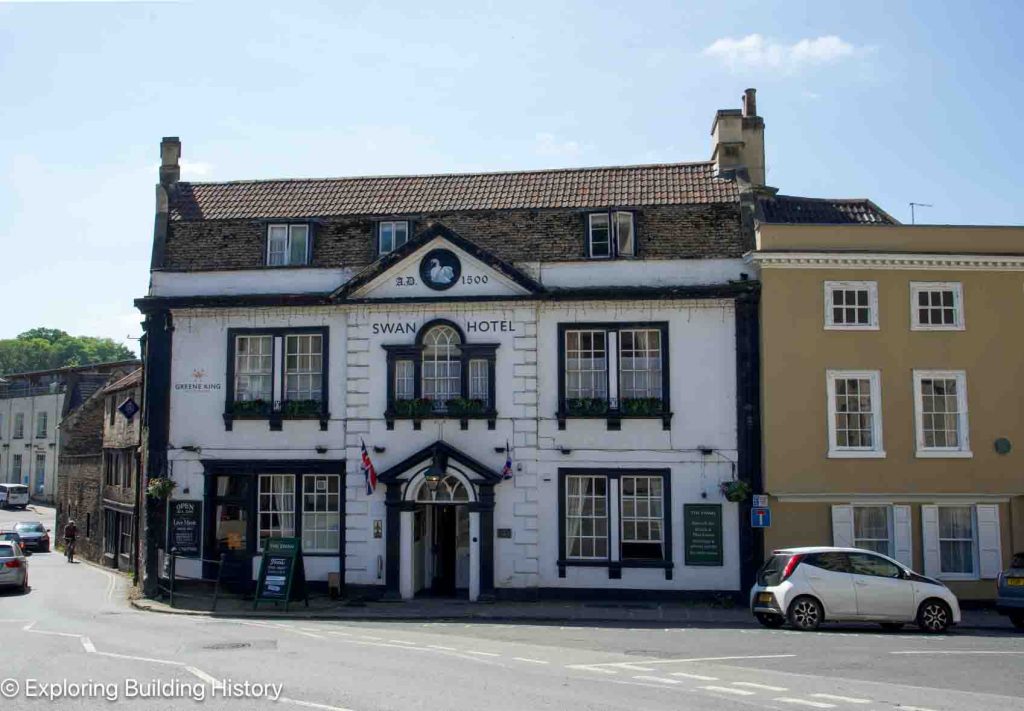
The Swan Hotel, Bradford-on-Avon, Wiltshire
The Venetian window was not confined to the aristocratic and collegiate. Two West Country buildings demonstrate its penetration into the domestic and commercial fabric. The Swan in Bradford-on-Avon—first documented as an inn in a lease of around 1631, and now a Grade II* listed building—acquired a handsome Georgian façade with a Venetian window above the principal entrance.11 The window announces ambition: a provincial inn aspiring to the standards of taste current in polite society.
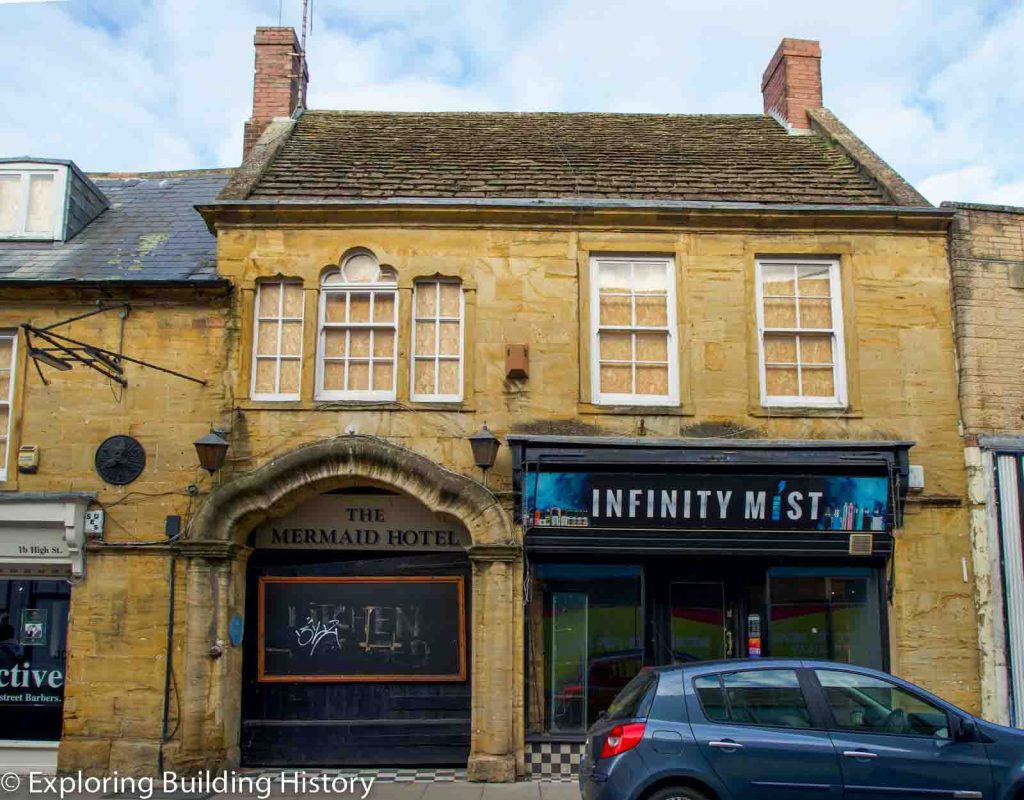
Mermaid Hotel with an adapted Venetian Window, Yeovil, Somerset
Comparable aspirations seem to have been at work at the Mermaid Inn in Yeovil, Somerset, a coaching inn with origins in the eighteenth century, where the same triple-light arrangement lifts a vernacular commercial building into the realm of architectural aspiration.12
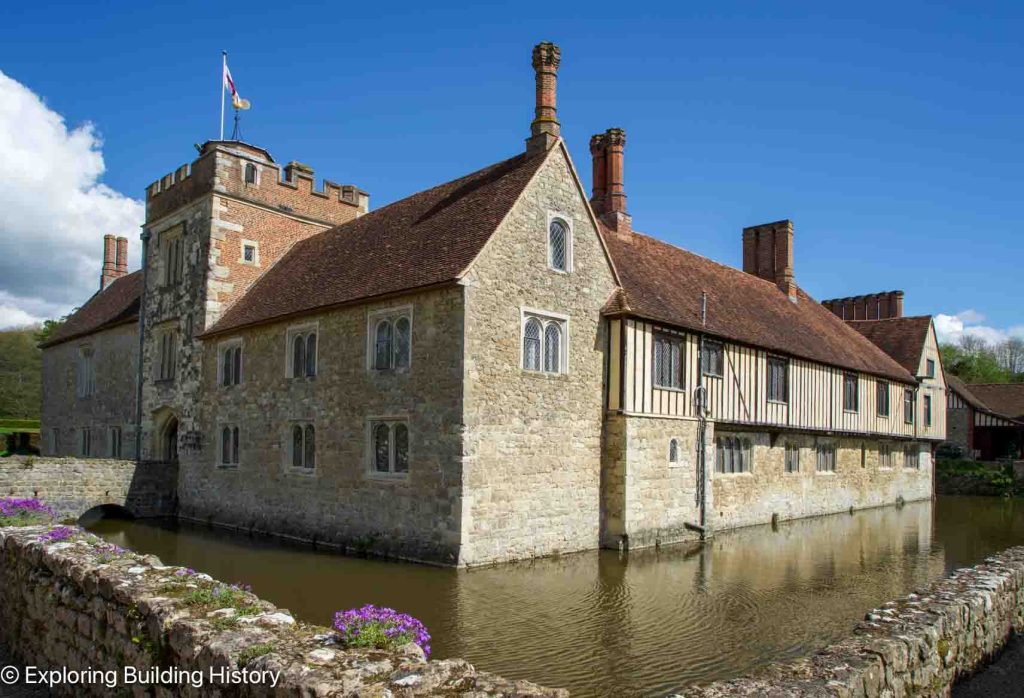
Ightham Moat, Kent
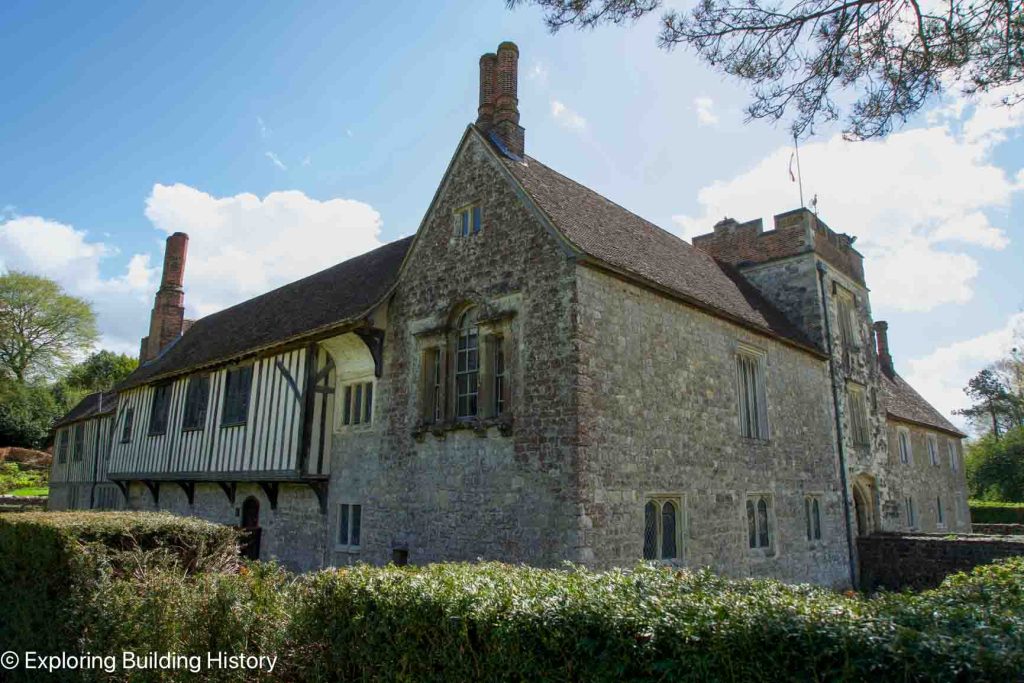
Ightham Moat, Serliana or Venetian Window inserted into a Medieval Moated Manor House
Strangest, perhaps, is the example at Ightham Mote in Kent, a medieval moated manor house with origins dating to around 1320.13 Medieval in its bones and romantic in its picturesque silhouette, Ightham Mote was nonetheless subjected to Georgian improvements that included the insertion of Palladian windows into its ancient walls – a collision of medieval continuity with Enlightenment taste that tells us much about the social and aesthetic pressures of the eighteenth century. Even the owners of a moated manor felt the compulsion of what was refined and new. The desire to admit more light was of course also practical, but the chosen form was never merely pragmatic: it spoke a language that the period understood immediately.
Conclusion
The Venetian window, from Serlio’s theoretical codification in 1537 to its appearance in provincial inns and medieval manor houses across England, traces a remarkable arc of architectural transmission. What began as a structural solution – how to light a wide opening beneath an arch – became a vehicle for aspiration: intellectual, social, and aesthetic. Wherever it appears, from the loggias of the Basilica Palladiana to the façade of a Wiltshire coaching inn, the Venetian window speaks the same grammar of cultivated ambition. That a form codified in sixteenth-century Venice should animate the façade of a Somerset inn or the medieval courtyard of a Kentish manor house is not merely an architectural curiosity: it is a measure of the extraordinary reach of Renaissance ideas, and of the enduring human desire to align oneself with beauty.
Look as you go about your travels. The Venetian window holds its currency as an architectural form throughout the United Kingdom and far beyond.
NOTES
1. Sebastiano Serlio, Tutte l’opere d’architettura et prospetiva (Venice, 1537). The fourth book, Regole generali, was the first to appear and contains the window’s earliest systematic illustration. See also John Summerson, The Classical Language of Architecture (London: Thames and Hudson, 1963), pp. 43–46.
2. Lionello Puppi, Andrea Palladio (London: Phaidon, 1975), pp. 278–283; Howard Burns, Andrea Palladio 1508–1580: The Portico and the Farmyard (London: Arts Council of Great Britain, 1975), cat. no. 37. The basilica was inscribed as part of the UNESCO World Heritage Site ‘City of Vicenza and the Palladian Villas of the Veneto’ in 1994.
3. Vincenzo Scamozzi, L’idea dell’architettura universale (Venice, 1615). On Rocca Pisana see Guido Beltramini and Howard Burns (eds.), Vincenzo Scamozzi 1548–1616 (Venice: Marsilio, 2003); and Rudolf Wittkower, ‘Vincenzo Scamozzi’, The Burlington Magazine, 95 (1953), p. 171. The date of 1576 is recorded by Scamozzi in his treatise; most sources give a range of c. 1575–78.
4. Andrea Palladio, I quattro libri dell’architettura (Venice: Domenico de’ Franceschi, 1570). English edition: Isaac Ware (trans.), The Four Books of Architecture (London, 1738).
5. On Palazzo Pamphilj, see Anthony Blunt, Guide to Baroque Rome (London: Granada, 1982), pp. 85–87. For Sant’Agnese in Agone and Borromini’s involvement from 1653, see Anthony Blunt, Borromini (London: Allen Lane, 1979), pp. 122–145.
6. On Jones’s Italian journeys and his annotated copy of the Quattro Libri (Worcester College, Oxford, MS Jones 1), see John Harris and Gordon Higgott, Inigo Jones: Complete Architectural Drawings (London: Royal Academy, 1989); and John Newman, ‘Inigo Jones’s Architectural Education before 1614’, Architectural History, 35 (1992), pp. 1–26.
7. Colen Campbell, Vitruvius Britannicus, 3 vols. (London, 1715, 1717, 1725). On its role in the Palladian revival, see Rudolf Wittkower, Palladio and English Palladianism (London: Thames and Hudson, 1974).
8. John Summerson, Architecture in Britain 1530–1830, 9th edn. (New Haven and London: Yale University Press, 1993), pp. 315–320. Chiswick House is Grade I listed: Historic England, National Heritage List for England (NHLE), entry for Chiswick House.
9. Historic England, NHLE entry for Holkham Hall (Grade I). See also Leo Schmidt, Holkham Hall, Norfolk(Ashbourne: English Life Publications, 1978). The hall was begun in 1734; Thomas Coke died in 1759 before completion, and the project was overseen to its conclusion in 1764 by his widow, Lady Margaret Tufton.
10. Howard Colvin, A Biographical Dictionary of British Architects 1600–1840, 4th edn. (New Haven and London: Yale University Press, 2008), p. 232. The quadrangle’s north, east, and west ranges (Henry Aldrich, 1706–11) pre-date the library’s south range (attributed to George Clarke, begun 1717, completed 1772).
11. Historic England, NHLE entry for The Swan Hotel, Bradford-on-Avon (Grade II*). The building is first recorded in a lease of c.1631.
12. Specific published scholarship on the Mermaid Inn, Yeovil, is limited. For the Somerset vernacular and Georgian context, see Robert Dunning (ed.), A History of the County of Somerset, Victoria County History (London: Institute of Historical Research, 1974–), relevant volumes; and the Historic England NHLE entry for the building.
13. National Trust, Ightham Mote (visitor guidebook, current edition); Historic England, NHLE entry for Ightham Mote (Grade I). The core of the moated house dates to c.1320–1340. Georgian improvements, including the insertion of Palladian and Gothick windows and the installation of hand-painted Chinese wallpaper, were made in the eighteenth century.
BIBLIOGRAPHY
Primary Sources
Campbell, Colen. Vitruvius Britannicus. 3 vols. London, 1715, 1717, 1725.
Palladio, Andrea. I quattro libri dell’architettura. Venice: Domenico de’ Franceschi, 1570.
Serlio, Sebastiano. Tutte l’opere d’architettura et prospetiva. Venice, 1537.
Scamozzi, Vincenzo. L’idea dell’architettura universale. Venice: Giorgio Valentini, 1615.
Ware, Isaac (trans.). The Four Books of Architecture. London, 1738.
Secondary Sources
Beltramini, Guido, and Howard Burns (eds.). Vincenzo Scamozzi 1548–1616. Venice: Marsilio, 2003.
Blunt, Anthony. Borromini. London: Allen Lane, 1979.
Blunt, Anthony. Guide to Baroque Rome. London: Granada, 1982.
Burns, Howard. Andrea Palladio 1508–1580: The Portico and the Farmyard. London: Arts Council of Great Britain, 1975.
Colvin, Howard. A Biographical Dictionary of British Architects 1600–1840. 4th edn. New Haven and London: Yale University Press, 2008.
Dunning, Robert (ed.). A History of the County of Somerset. Victoria County History. London: Institute of Historical Research, 1974–.
Harris, John, and Gordon Higgott. Inigo Jones: Complete Architectural Drawings. London: Royal Academy, 1989.
Newman, John. ‘Inigo Jones’s Architectural Education before 1614’. Architectural History, 35 (1992), pp. 1–26.
Puppi, Lionello. Andrea Palladio. London: Phaidon, 1975.
Schmidt, Leo. Holkham Hall, Norfolk. Ashbourne: English Life Publications, 1978.
Summerson, John. Architecture in Britain 1530–1830. 9th edn. New Haven and London: Yale University Press, 1993.
Summerson, John. The Classical Language of Architecture. London: Thames and Hudson, 1963.
Wittkower, Rudolf. Palladio and English Palladianism. London: Thames and Hudson, 1974.
Online and Institutional Sources
Historic England. National Heritage List for England (NHLE). https://historicengland.org.uk/listing/the-list/[accessed April 2026].
National Trust. Ightham Mote (visitor guidebook, current edition).
UNESCO World Heritage Centre. ‘City of Vicenza and the Palladian Villas of the Veneto’. https://whc.unesco.org/en/list/712 [accessed April 2026].