
The parish church of St Peter & St Paul at Muchelney in the Somerset levels lies adjacent to the remains of Muchelney Abbey. Whilst there was an earlier church, the one standing today is mainly a late 15th-century[i] construction of Blue Lias and Ham Hill stone.
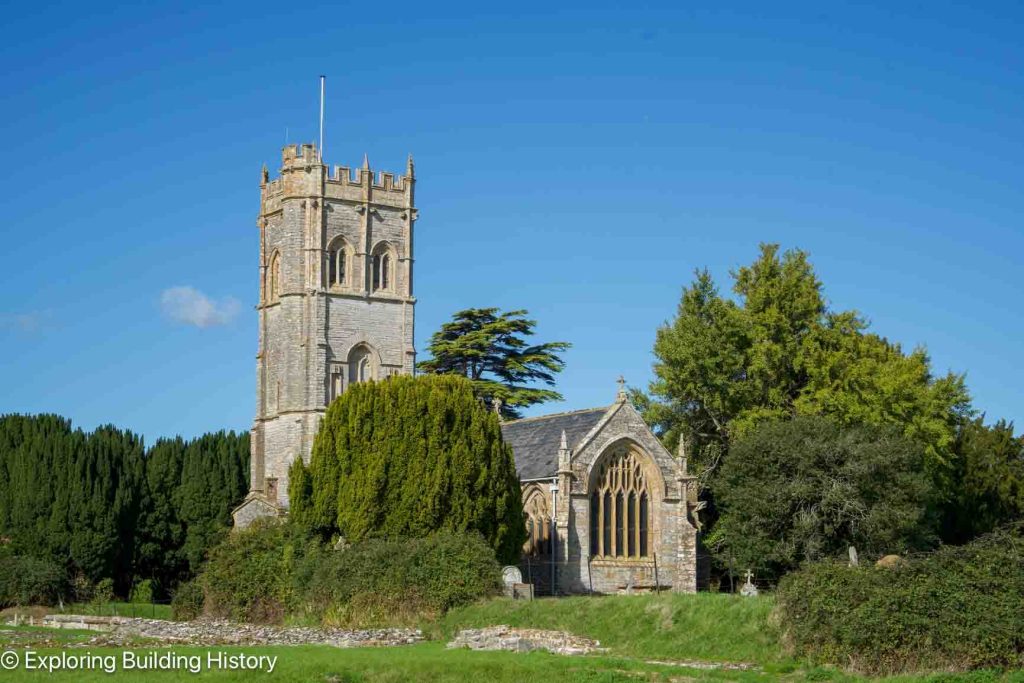
15th C Muchelney Church on the Somerset Levels
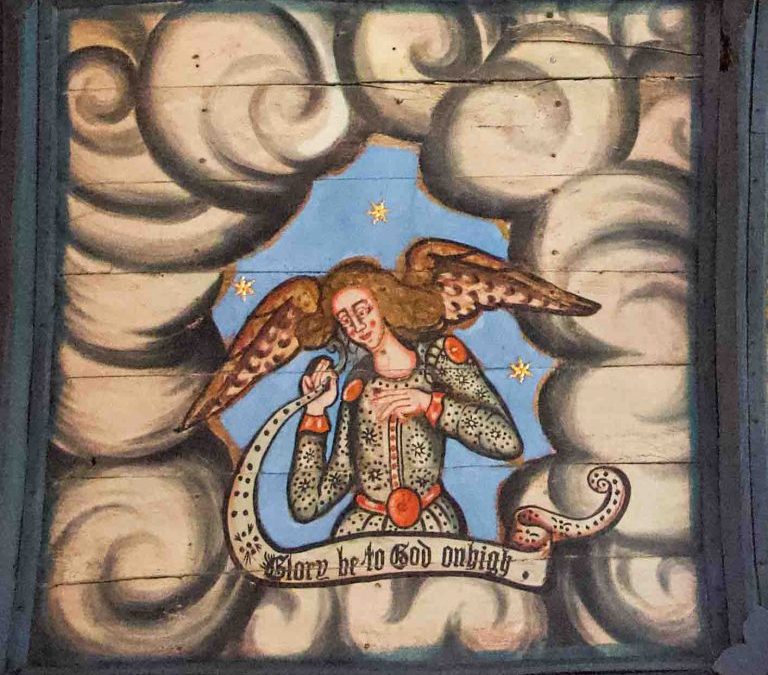
In the nave towards the west end of the wagon roof is a painted set of panels depicting angels with joyful scrolls looking down from a blue sky dotted with golden stars, framed with swirling clouds. The costumes of the angels are Elizabethan, and the cloud depictions suggest early 17th century.[ii]
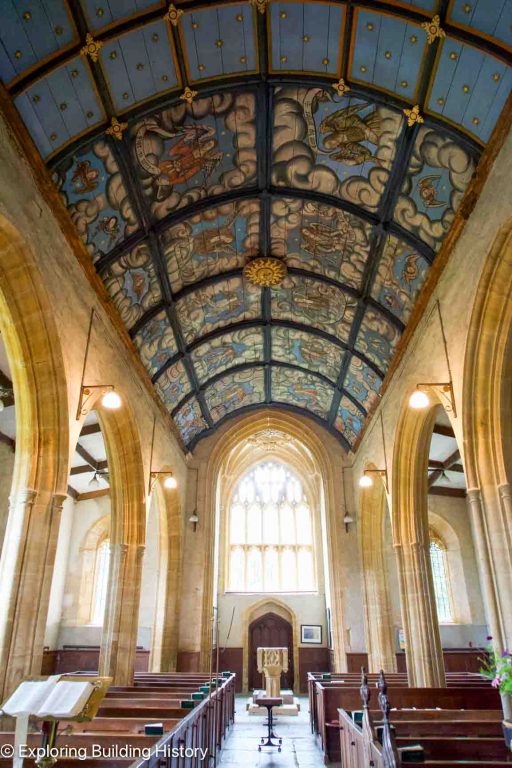
Muchelney Church Nave Painted Ceiling (early 17th C)
With the counter-form of Laudianism under Charles I against the rise of Puritanism, painted ceilings were part of the scheme of the ‘Beauty of Holiness’. This would fit with the period of 1632-1646 when Bishop William Piers enforced the agenda of Archbishop Laud across the Diocese of Bath and Wells. It is quite possible the ceiling dates from this period. For more information on the ‘Beauty of Holiness’ in Somerset see the post on St Cuthbert’s in Wells – Pulpit at St Cuthbert’s, Wells, Somerset
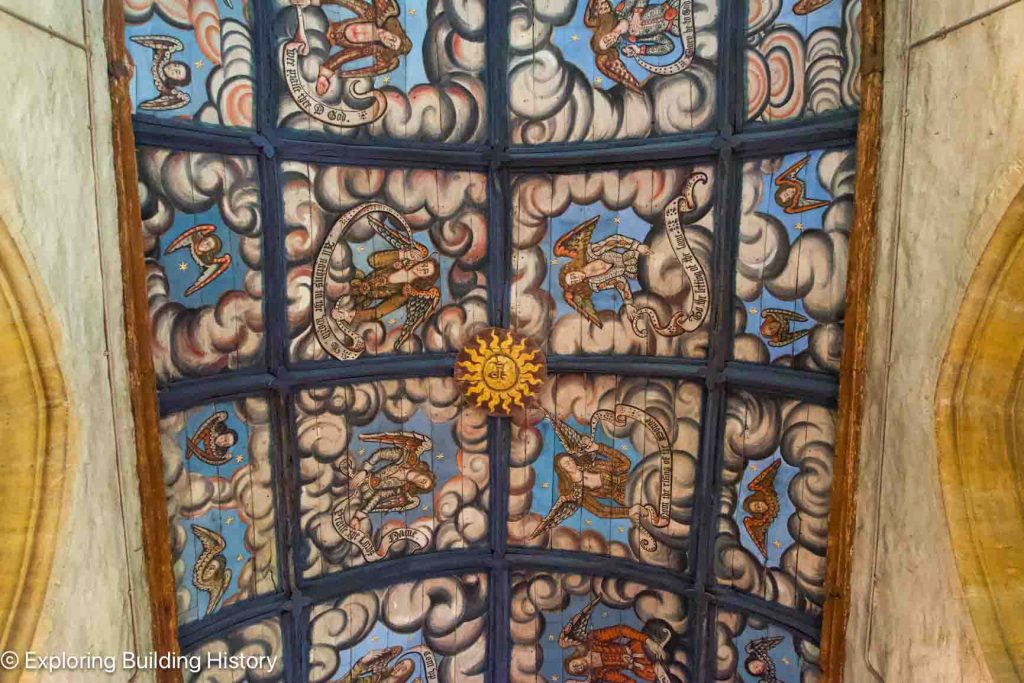
A Section of the early-17th Painted Ceiling
Below are the ten individual panels with the angels and their messages (I have transcribed as written, hence the letter ‘f’ is pronounced ‘s’). The order is from the east going west and left to right. There is variety in the angels, i.e. each one is unique facially, their dress, hairstyles, wings and stances. It may suggest some relationships between them and real people of the time; perhaps local parishioners, patrons, artisans or clergy. Angels are often rendered as idealised, interchangeable figures.
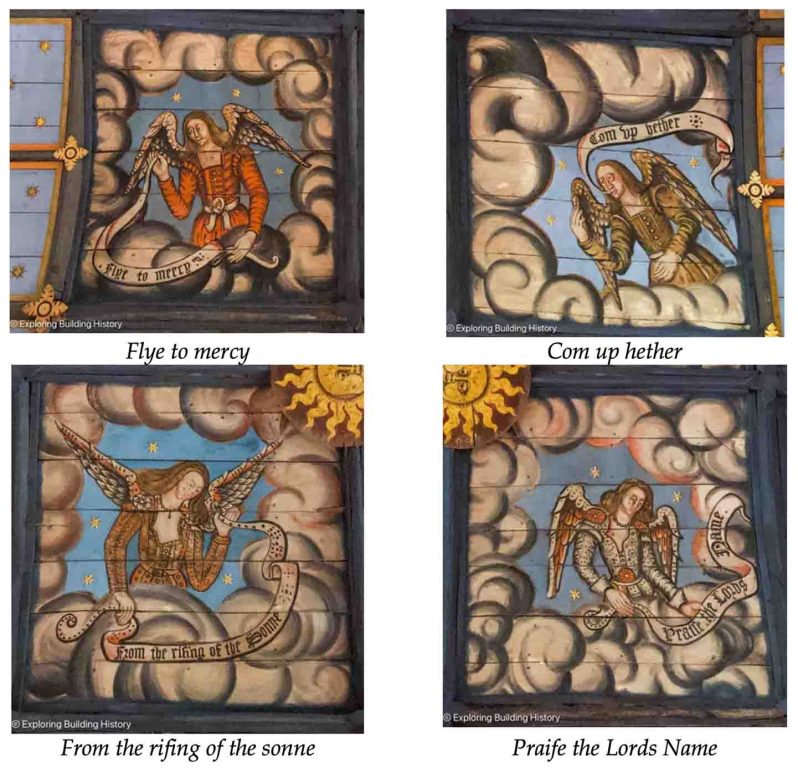
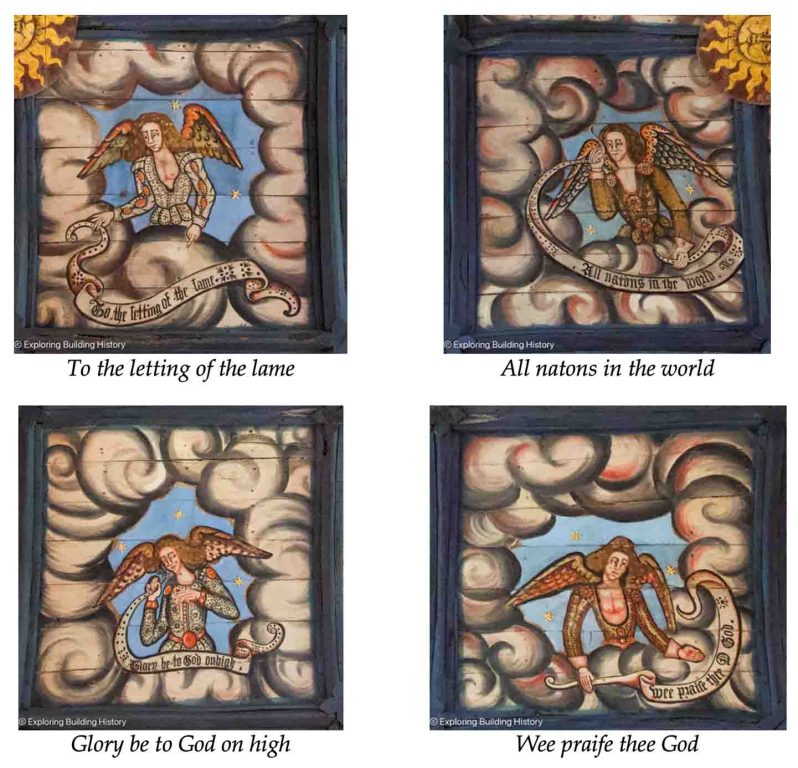
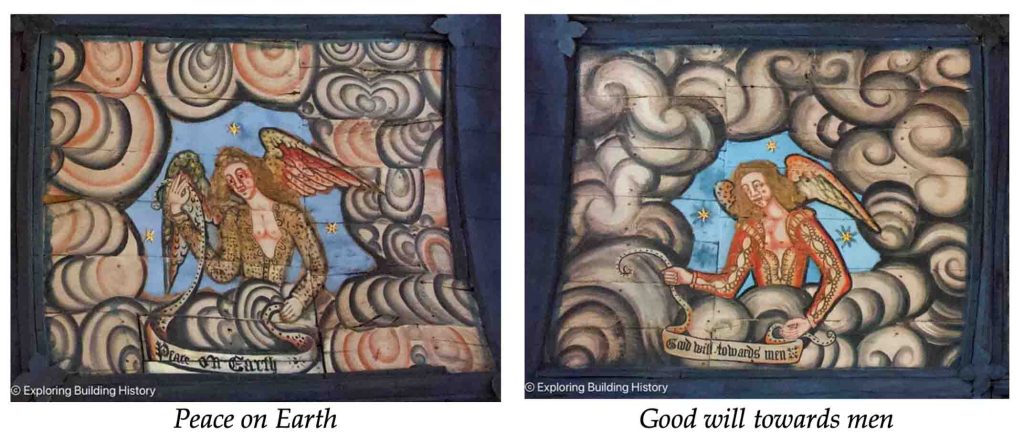
The cloud bursts also have a unique touch in each of the panels. I am no expert on the dress of the time but they do seem masculine angels. Some of them appear a little fuller in their bare chests and some of them have their chests completely covered. Perhaps it was the whimsical nature of the artist(s) to have a bit of originality with their images. Perhaps too, the individuality had some local connection and saved the ceiling from the blotting-out hand of the Puritans.
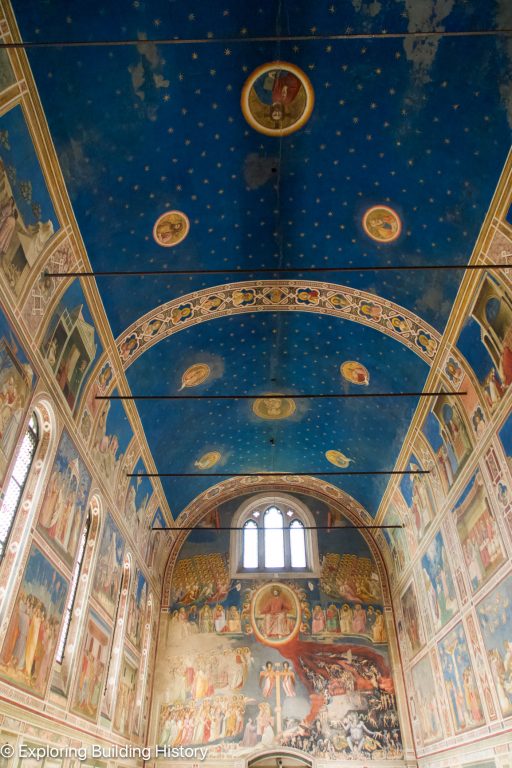
Scrovengi Chapel, Padua, Giotto’s Ceiling of early 14th C
There is a striking similarity to the fresco ceiling of the Scrovengi Chapel in Padua, painted in 1303–5 by Giotto: the same blue sky with gold stars, and the same wagon-roof shape. Ideas flowed westwards and in a quiet corner of the Somerset Levels a few centuries later, the blue sky with gold stars became the backdrop to another beautiful, unique ceiling.
NOTES
[i] Julian Orbach and Nikolaus Pevsner, Somerset: South and West (New Haven and London: Yale University Press, 2014), p. 475
[ii] Orbach, p. 475.
BIBLIOGRAPHY
Orbach, Julian and Nikolaus Pevsner, Somerset: South and West (New Haven and London: Yale University Press, 2014)
Chisholm, Mary, ‘Church of St. Cuthbert, Wells: A Carved Pulpit of Independence – 1636’, Exploring Building History(20 Feb 2026) <https://www.exploringbuildinghistory.co.uk/church-of-st-cuthbert-wells-a-carved-pulpit-of-independence-1636/)>