
Introduction
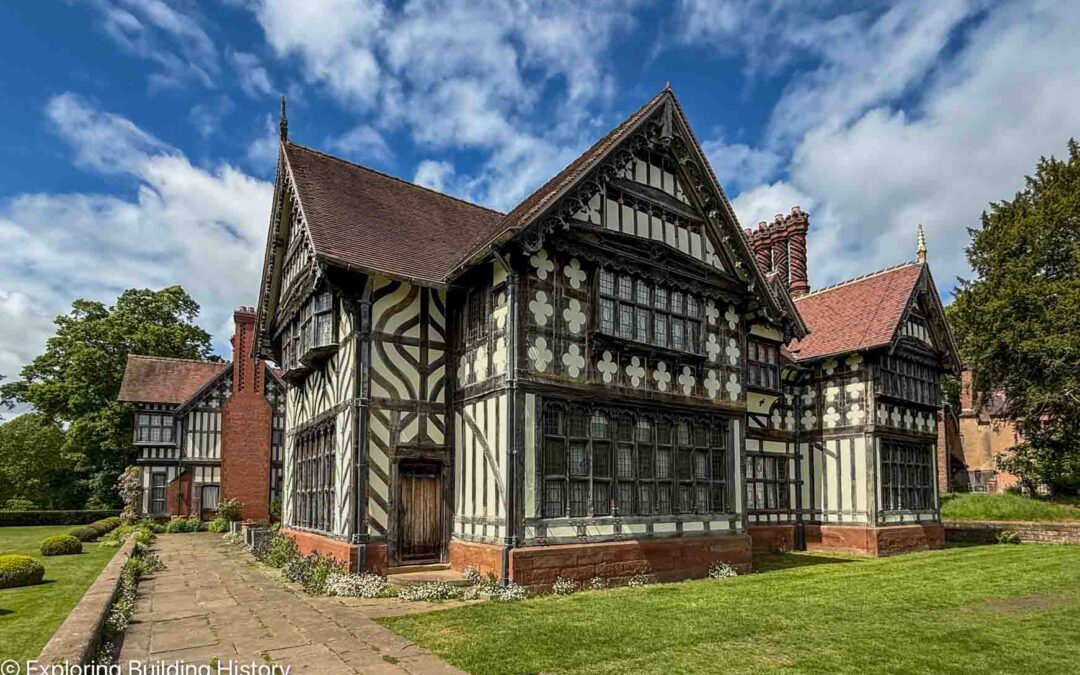
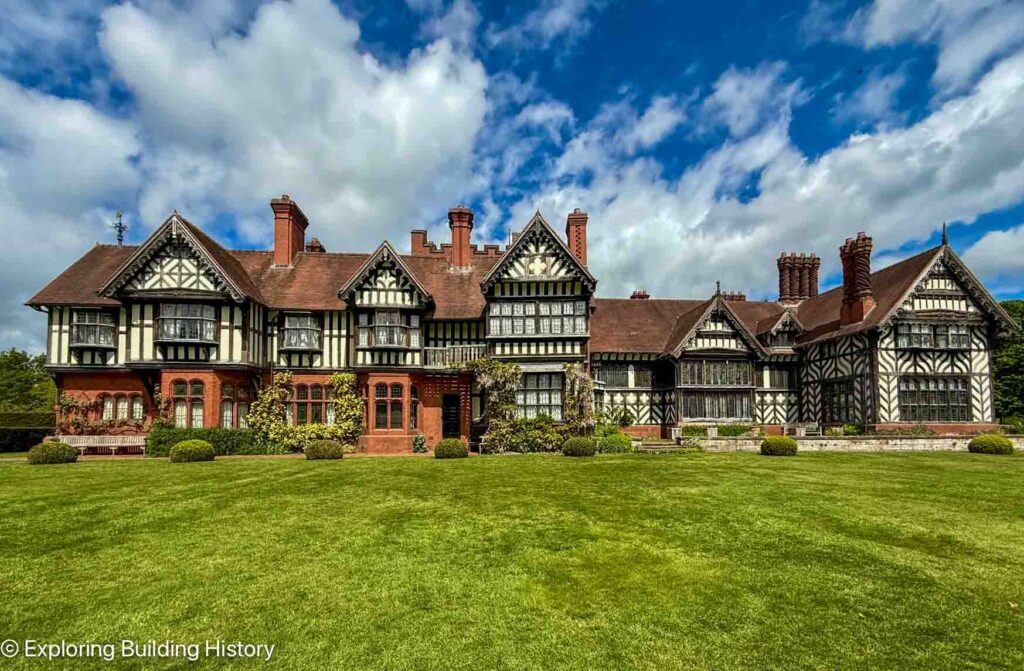
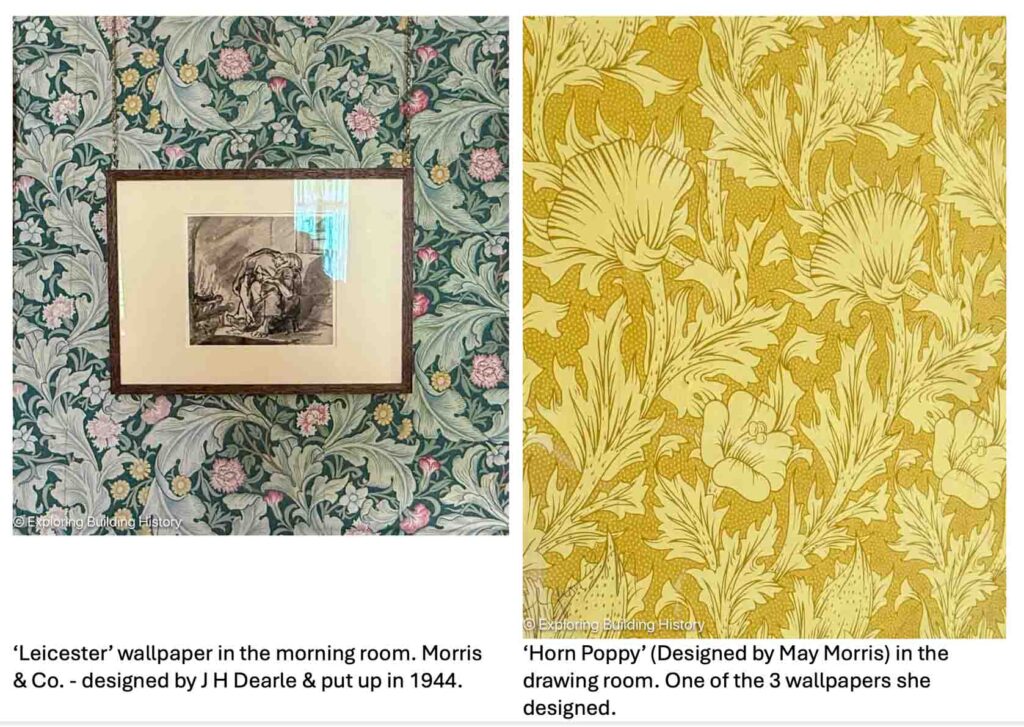
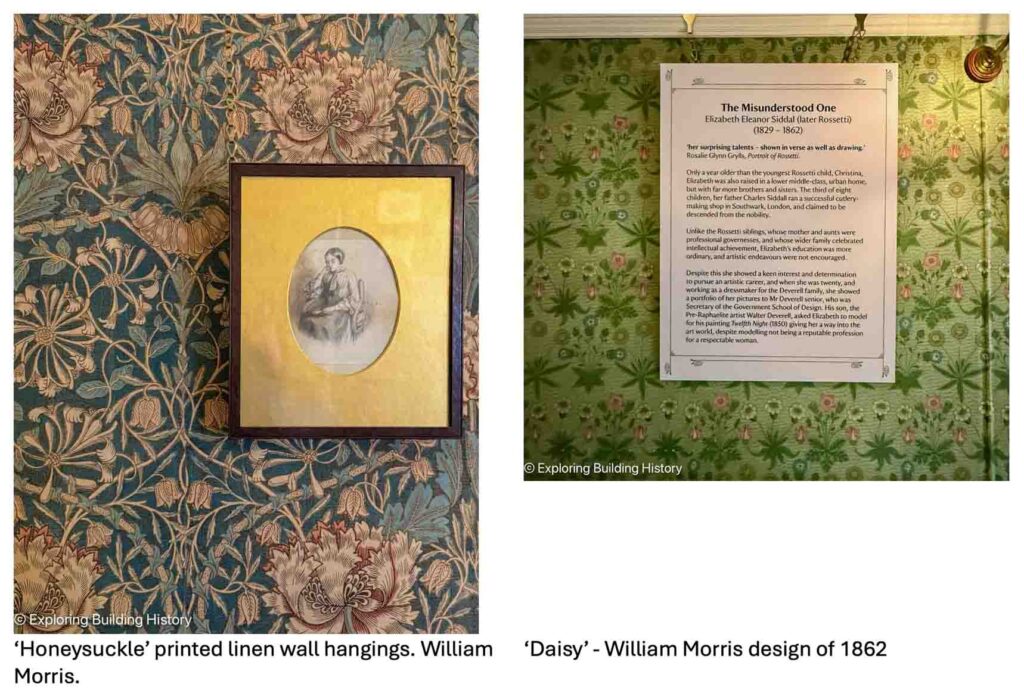
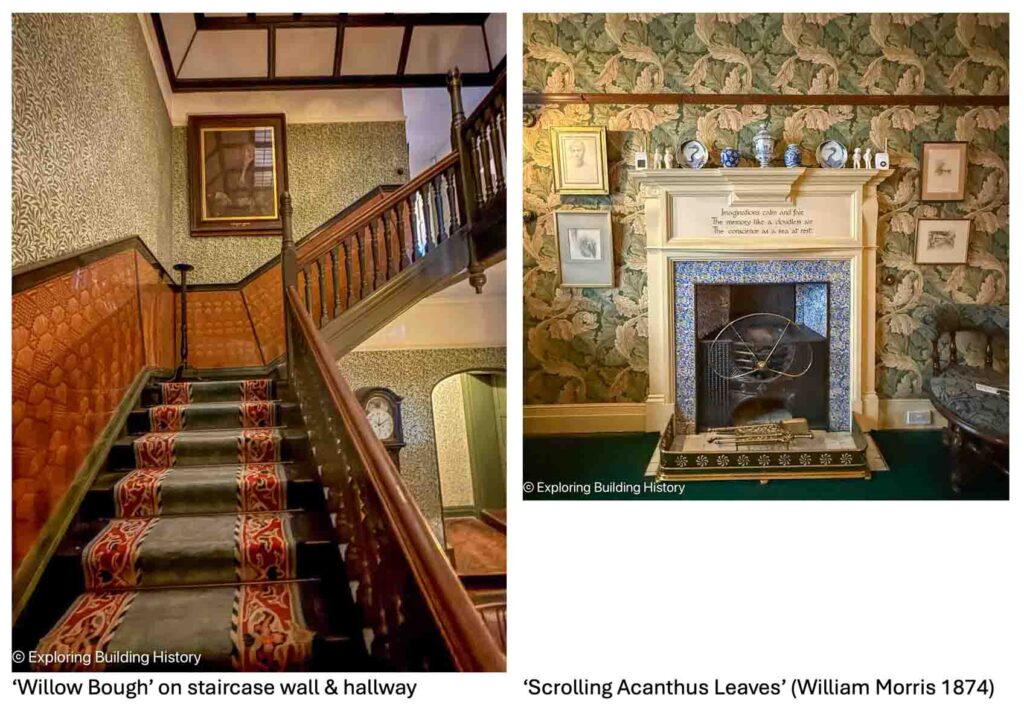
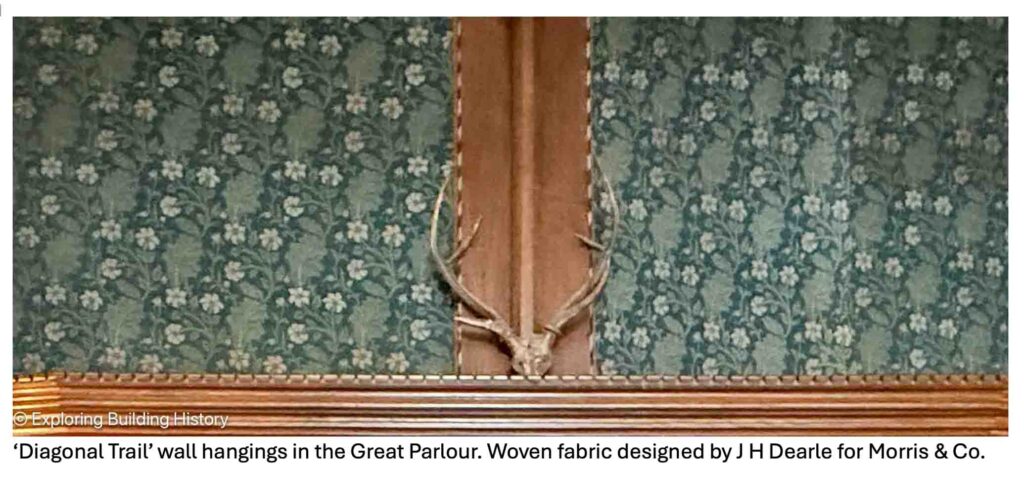
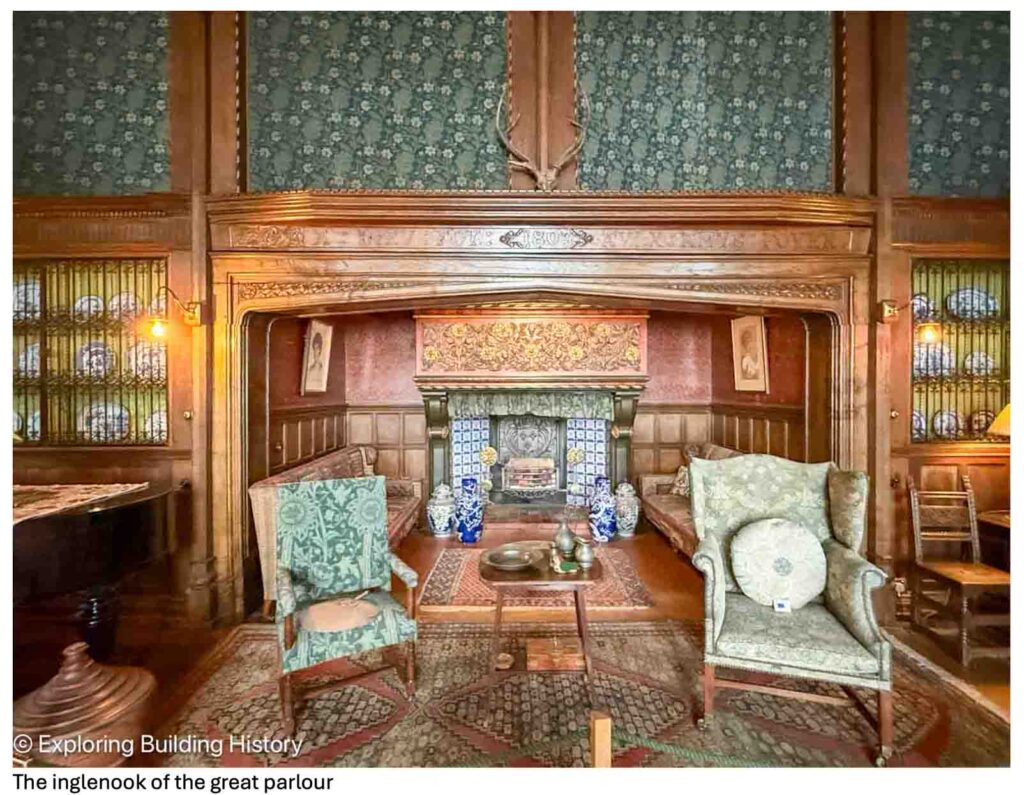
There are houses that preserve a moment, and then there are houses that embody one. Wightwick Manor, the Victorian house near Wolverhampton now in the care of the National Trust, belongs firmly to the second category. Built in two phases between 1887 and 1893 for the paint manufacturer Theodore Mander, it was furnished and decorated almost entirely with products from Morris & Co., the design firm founded by William Morris in 1861. Walking through its rooms today, one encounters what amounts to a curated anthology of Morris & Co.’s wallpaper and wall hanging designs: ‘Honeysuckle’, ‘Daisy’, ‘Horn Poppy’, ‘Willow Bough’ ‘Diagonal Tail’ & ‘Leicester’ to name a selection. To understand these patterns fully, however, it is necessary to set them within their proper historical and intellectual context.
Wightwick Manor
William Morris: Life, Vision, and Dissent
William Morris (1834–1896) was born into prosperous circumstances in Walthamstow, Essex, the son of a city bill broker whose early death left the family comfortably endowed.1 Educated at Marlborough and then Exeter College, Oxford, Morris entered a world of intense artistic and intellectual ferment. His friendship with Edward Burne-Jones drew him towards the circle of John Ruskin and the Pre-Raphaelite Brotherhood, whose rejection of academic convention and celebration of medieval craftsmanship would prove decisive.2
What emerged from these influences was not simply an aesthetic preference but a moral philosophy. Morris believed, with a conviction that deepened into political socialism in later life, that industrial capitalism had sundered the relationship between maker and made object, producing goods that were ugly because they were made by people who took no pleasure in making them. His rallying injunction — ‘Have nothing in your houses that you do not know to be useful or believe to be beautiful’ — was less a decorator’s maxim than a manifesto.3 The founding of Morris, Marshall, Faulkner & Co. in 1861 (reorganised as Morris & Co. in 1875) was an attempt to demonstrate that beautiful, well-made objects could be produced as a matter of principle, not exception.
A Brief History of Wallpaper
Wallpaper, as a distinct decorative category, emerged in Europe during the sixteenth century as an affordable substitute for woven tapestry and painted cloth hangings.4 The earliest European examples, dating to around 1509 and associated with the English printer Hugo Goes, consisted of single sheets of printed paper, often block-printed in imitation of textile patterns. By the seventeenth century, hand-painted Chinese wallpapers — depicting birds, flowers, and landscapes in elaborate detail — had become status symbols in the grandest European interiors, arriving as trade goods through the East India Companies.5
The eighteenth century saw the manufacture of wallpaper systematised and democratised. The introduction of continuous paper rolls (replacing individual sheets) and the development of mechanised printing from the 1830s onwards transformed it from a luxury into a mass-market commodity. A tax on wallpaper, levied in Britain from 1712 and not repealed until 1836, had for over a century constrained production; once lifted, the market expanded dramatically.6 By the time of the Great Exhibition of 1851 — which Morris, characteristically, found largely repellent — wallpaper had become one of the defining surfaces of the Victorian interior.7
Morris’s Approach to Pattern Design
Morris began designing wallpapers in the early 1860s, though his first commercial success in the medium came with ‘Trellis’ (1864), a pattern of roses and birds woven through a wooden trellis. The garden at Red House in Bexleyheath, which Philip Webb had designed for Morris and his wife Jane, provided direct inspiration.8 From the outset, his approach was rooted in a deep engagement with natural form and historical precedent. He studied medieval manuscripts, Persian textiles, and — above all — the botanical variety of the natural world around him.9
Morris was emphatic that pattern should not deceive the eye into thinking it sees depth or three-dimensional space; the flatness of the surface should be acknowledged and celebrated through stylised, rhythmic repetition. ‘Do not be afraid of large patterns’, he counselled; ‘if properly designed they are more restful to the eye than small ones.’10 His wallpapers were printed using traditional wood-block methods — at Jeffrey & Co. of Islington, his principal printer from 1864 — which allowed a richness of colour and texture that roller printing could not replicate.11
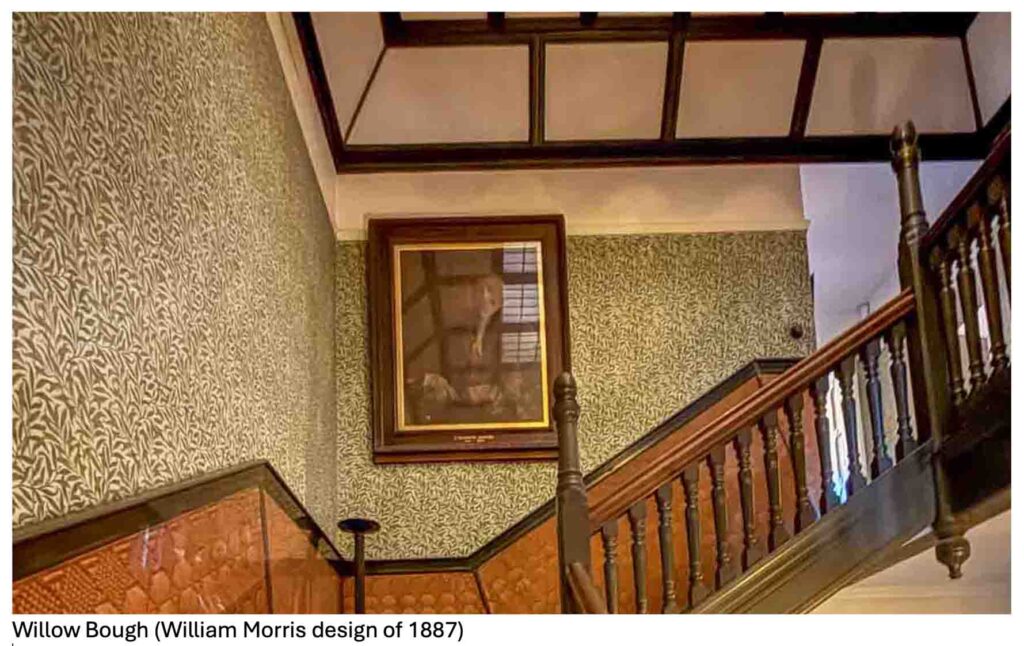
The designs that followed over the next three decades form one of the most sustained and coherent bodies of pattern work in British design history. ‘Daisy’ (1862), ‘Pomegranate’ (1864), ‘Jasmine’ (1872), ‘Acanthus’ (1875), ‘Pimpernel’ (1876), ‘Sunflower’ (1879), ‘Willow Bough’ (1887) — each represented a precise solution to the problem of how to translate natural growth into flat, repeating ornament without either slavish literalism or sterile abstraction.12
Wightwick Manor: A Morris Interior Intact
Wightwick Manor’s significance as a repository of Morris designs can scarcely be overstated. Theodore Mander and his wife Flora began acquiring Morris & Co. products in the late 1880s, at a time when the firm’s reputation was at its height and its influence on progressive middle-class taste was considerable.13 The house was subsequently enriched by their son Geoffrey Mander, a Liberal MP, and his wife Rosalie — herself a noted collector — before being given to the National Trust in 1937. Crucially, the family’s stewardship preserved the original decorative schemes largely intact; Wightwick thus escaped the fate of many Victorian interiors, stripped and redecorated by successive generations with different tastes.14
The wallpapers encountered throughout Wightwick’s rooms represent a remarkable cross-section of Morris’s output. In the Great Parlour, ‘Sunflower’ — a bold, confident design first issued in 1879 and requiring some forty wood blocks for printing — covers the upper walls above the inglenook fireplace, its large-scale repeat demonstrating precisely Morris’s contention that generous pattern is more, not less, visually calming than busy repetition.15
‘Pimpernel’, found elsewhere in the house, belongs to a different register: a tighter, more intricate design in which stylised flowers turn on a formal ogival framework derived from Islamic tile-work and medieval European weaving. The design rewards close looking — as Morris always intended — revealing within its apparent symmetry a subtle variation in the treatment of leaf and stem that prevents mechanical monotony.16
‘Larkspur’, ‘Trellis’, and ‘Willow Bough’ also appear in the house, each exemplifying distinct strategies within Morris’s broader approach. ‘Trellis’ — the earliest — retains the charm of a garden painting translated into flat pattern; ‘Larkspur’, with its rhythmic vertical movement, draws on the tradition of the millefleurs tapestry; ‘Willow Bough’, the latest and notable for its restrained near-monochrome palette, shows Morris’s mature simplification of natural form into something approaching the decorative logic of Japanese woodblock prints.17
Legacy and Continuing Relevance
Morris wallpapers were expensive in their own day — their labour-intensive production methods ensured they remained beyond the reach of the working class Morris theoretically championed, a contradiction he acknowledged with characteristic honesty.18 But the reforming principles they embodied — that pattern should derive from natural sources, that craft processes deserved respect, that beauty and daily life need not be strangers — permeated the Arts and Crafts movement across Britain, Europe, and North America, influencing designers from Charles Voysey to Frank Lloyd Wright.19
At Wightwick, these patterns exist not in the abstraction of a museum case or a design history textbook, but in the setting for which they were intended: on walls, in rooms, surrounded by light and furniture and the smell of old wood. That is a rarity in itself. That the collection spans so many of Morris’s key designs, in conditions so faithfully preserved, makes Wightwick something rarer still — an opportunity to experience the Morris interior not as reconstruction but as survival.
Unfortunately, I did not capture all the wallpaper and wall hanging designs with my camera. Hopefully a future visit will remedy the problem!
[Photographs by the author. Wightwick Manor is a National Trust property open to visitors; see nationaltrust.org.uk for details.]
Notes
- Fiona MacCarthy, William Morris: A Life for Our Time (London: Faber & Faber, 1994), pp. 1–20.
- E. P. Thompson, William Morris: Romantic to Revolutionary (London: Lawrence & Wishart, 1955), p. 31.
- William Morris, ‘The Art of the People’ (1879), in Hopes and Fears for Art (London: Ellis & White, 1882), p. 37.
- Charles Oman and Jean Hamilton, Wallpapers: A History and Illustrated Catalogue of the Collection of the Victoria and Albert Museum (London: Sotheby Publications / V&A, 1982), p. 1.
- Lesley Hoskins (ed.), The Papered Wall: The History, Patterns and Techniques of Wallpaper (London: Thames & Hudson, 1994), pp. 14–17.
- Ibid., pp. 22–30.
- Joanna Banham, Sally MacDonald and Julia Porter, Victorian Interior Design (London: Cassell, 1991), p. 88.
- Linda Parry, William Morris Textiles (London: V&A Publications, 1983), p. 12.
- MacCarthy, William Morris, pp. 125–128.
- ‘William Morris to Andreas Scheu’, 5 September 1883, in Norman Kelvin (ed.), The Collected Letters of William Morris, vol. II (Princeton: Princeton University Press, 1987), p. 229.
- Parry, William Morris Textiles, pp. 48–52.
- Gillian Naylor, William Morris by Himself: Designs and Writings (London: Macdonald Orbis, 1988), p. 74.
- Stephen Wildman (ed.), Wightwick Manor (London: National Trust, 2002), p. 6.
- Ibid., pp. 8–11.
- Oliver Fairclough and Emmeline Leary, Textiles by William Morris and Morris & Co. 1861–1940 (London: Thames & Hudson, 1981), pp. 30–35.
- National Trust, Wightwick Manor and Gardens (Swindon: National Trust, repr. 2025), p. 22.
- Wildman, Wightwick Manor, pp. 14–18.
- Parry, William Morris Textiles, p. 60.
- MacCarthy, William Morris, p. 463.
Select Bibliography
Banham, Joanna, Sally MacDonald and Julia Porter, Victorian Interior Design (London: Cassell, 1991)
Fairclough, Oliver and Emmeline Leary, Textiles by William Morris and Morris & Co. 1861–1940 (London: Thames & Hudson, 1981)
Hoskins, Lesley (ed.), The Papered Wall: The History, Patterns and Techniques of Wallpaper (London: Thames & Hudson, 1994)
MacCarthy, Fiona, William Morris: A Life for Our Time (London: Faber & Faber, 1994)
Morris, William, Hopes and Fears for Art (London: Ellis & White, 1882)
National Trust, Wightwick Manor and Gardens (Swindon: National Trust, repr. 2025)
Naylor, Gillian, William Morris by Himself: Designs and Writings (London: Macdonald Orbis, 1988)
Oman, Charles and Jean Hamilton, Wallpapers: A History and Illustrated Catalogue of the Collection of the Victoria and Albert Museum (London: Sotheby Publications / V&A, 1982)
Parry, Linda, William Morris Textiles (London: V&A Publications, 1983)
Thompson, E. P., William Morris: Romantic to Revolutionary (London: Lawrence & Wishart, 1955)
Wildman, Stephen (ed.), Wightwick Manor (London: National Trust, 2002)