
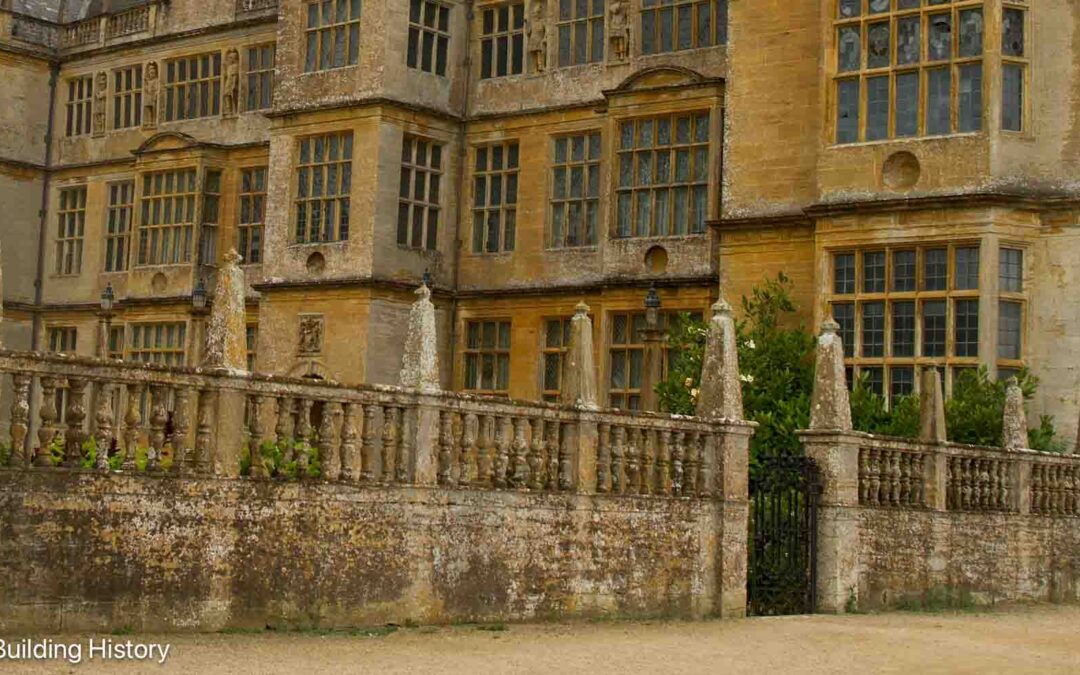
Surrounding the east court of Montacute House is a balustrade, an elegant feature idea that made its way from Renaissance Italy. Often used for loggias and balconies, it has been applied at Montacute as a running feature on top of a wall. The balustrade is punctuated with pinnacles. It is interesting how the English Renaissance interpreted motifs that made their way across from Italy. They were at home with both gothic motifs and Renaissance ones.
The wall with a balustrade on top keeps the east court private and enclosed. However, there is the ability to view the surrounding landscape through the raised balustrade. At the east end of the east court the wall and balustrade are likely not of the original build as there was a gatehouse around that position. Although the balustrade may have been re-sited if the gatehouse stood further out into the park. Unfortunately, apart from inventories, information on the original gatehouse has not been recorded.
The east court of the house (completed circa 1603) was most likely contemporary with the house, although things may have been moved. For example, the corner pavilions were reduced by a storey sometime around or after 1780. William Arnold’s flair as master mason is evident in the curious mini-temple feature set in the balustrade, topped with a pierced, hollow finial.
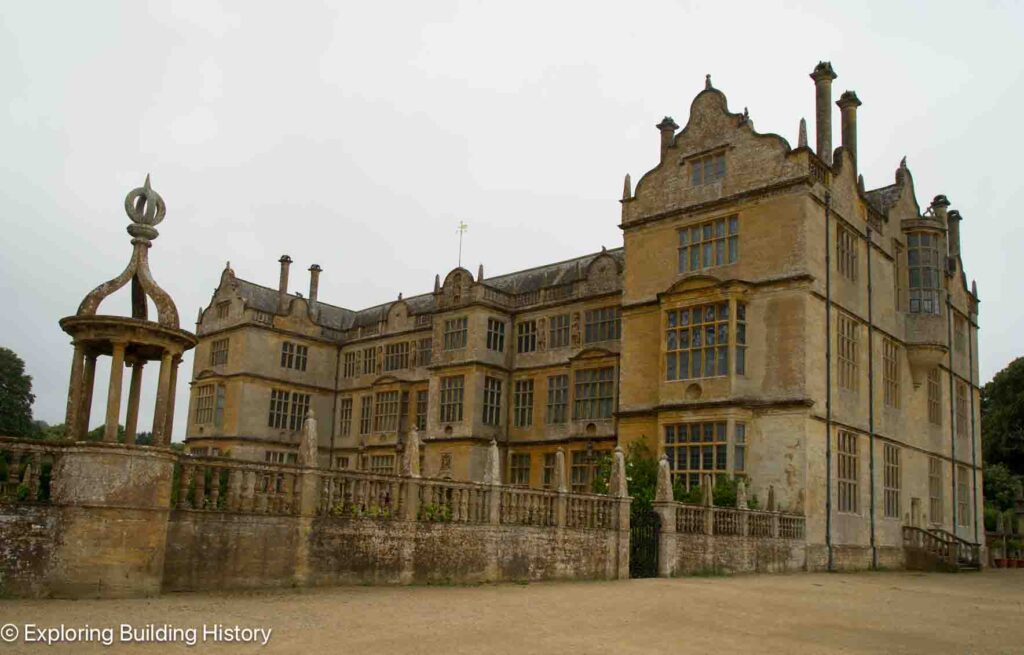
William Arnold: The likely master mason at Montacute
William Arnold (c. 1560-1637) was the likely master mason at Montacute, and his likely father, Arnold Goverson, worked on Longleat House, some thirty miles away in Wiltshire.[i] Whilst Robert Smythson (c. 1535-1614) was the main architect, Sir John Thynne (c. 1512-1580) had a significant hand in its design, and reflects a time when patrons had access to the innovative designs arriving from Europe. The house was completed by 1580, and balustrades were part of the design. They are on the stairs leading up to the entrance and right at the top of the house, surrounding the roof line. The Tudors liked the idea of the ‘pudding’ or ‘banqueting’ house where the family and guests could partake of a sweet treat and enjoy a view or entertainment. At Longleat this was set on the roof with the breathtaking views across the estate.
The gentry maintained a strong network and shared ideas as well as recommending architects, master masons and gifted artisans. In early 1610 Dorothy Wadham was planning the building of a new Oxford college in memory of her husband, Nicholas. This was to be Wadham College. She needed to sort out a master mason and a letter that survives provides the details.
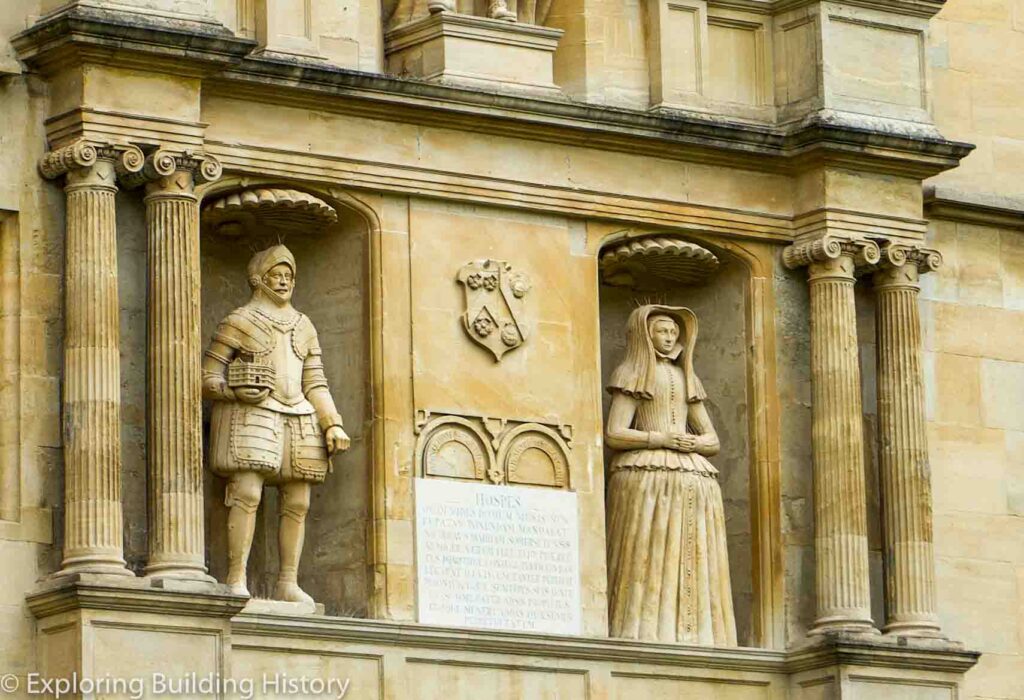
Statues of Nicholas & Dorothy Wadham at Wadham College, Oxford
William Arnold as recommended by Sir Edward Phelips
In a letter Dorothy wrote to her brother, John, Lord Petre, dated 10 February 1609/10 (D/DP Q13/3/7), she explains her building project and mentions the mason she intends to employ. She explains that Arnold had been recommended to her “by my good frend and lovinge neighboure, Sir Edward Phelipps”.[ii]
This letter tells us that William was well known to Sir Edward Phelips and is part of the evidence that points towards him being the likely master mason of Montacute. William may have worked to learn his art of the balustrade at Longleat, which he employed at Montacute.
A balustrade is made up of individual balusters
William Arnold’s balustrading was likely the first attempt his workshop of masons had in working with Ham Hill Stone for such a design.
To look a bit closer, here are the elements that make up a baluster.
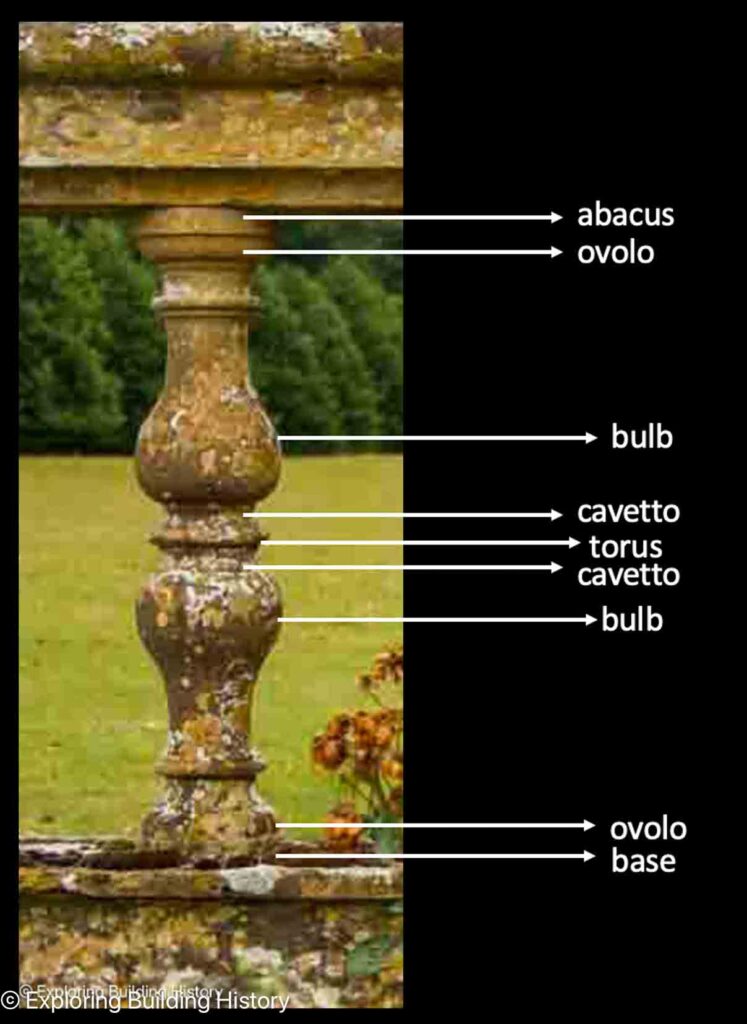
Individual baluster at Montacute House with elements labelled
It is curious how the eye glancing around will take the balustrade to contain identical balusters, all neatly uniform and in even-spaced lines. Looking closely, they are not uniform. The Ham Hill masons tried their best to create the masterful workshops of Florence and did a reasonable job.
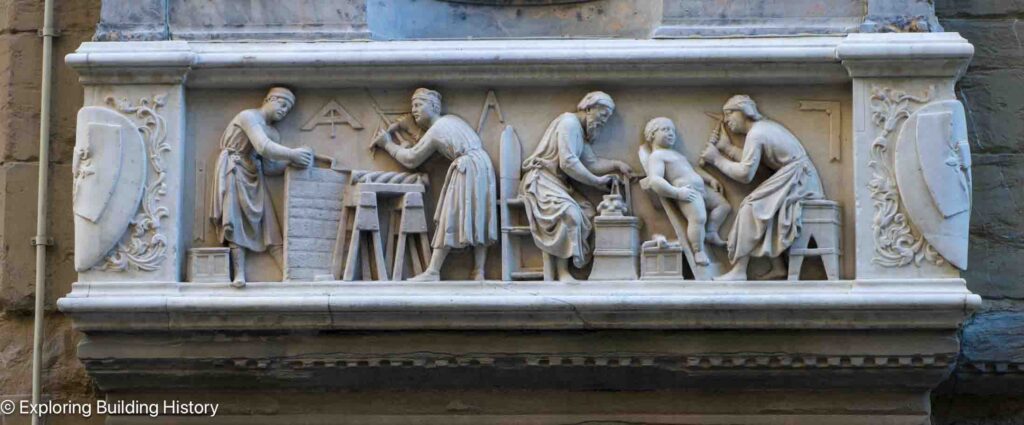
Relief sculpture below a niche on the side of the Church of Orsanmichele in Florence
Bulb size variation occurs within the balustrade sections
The curious thing is the differences likely indicate the individual hands at work. Some have fuller rounded bulbs, and some are slimmer. Below are two sections from the north side of the east court, stretching from the house. The individual balusters appear symmetrical when viewed top to bottom. Each bulb is reasonably uniform in terms of the top and base. Also, the cavettos are reasonably good in terms of lining up when each baluster is put in a row. However, the bulb sizes do vary.
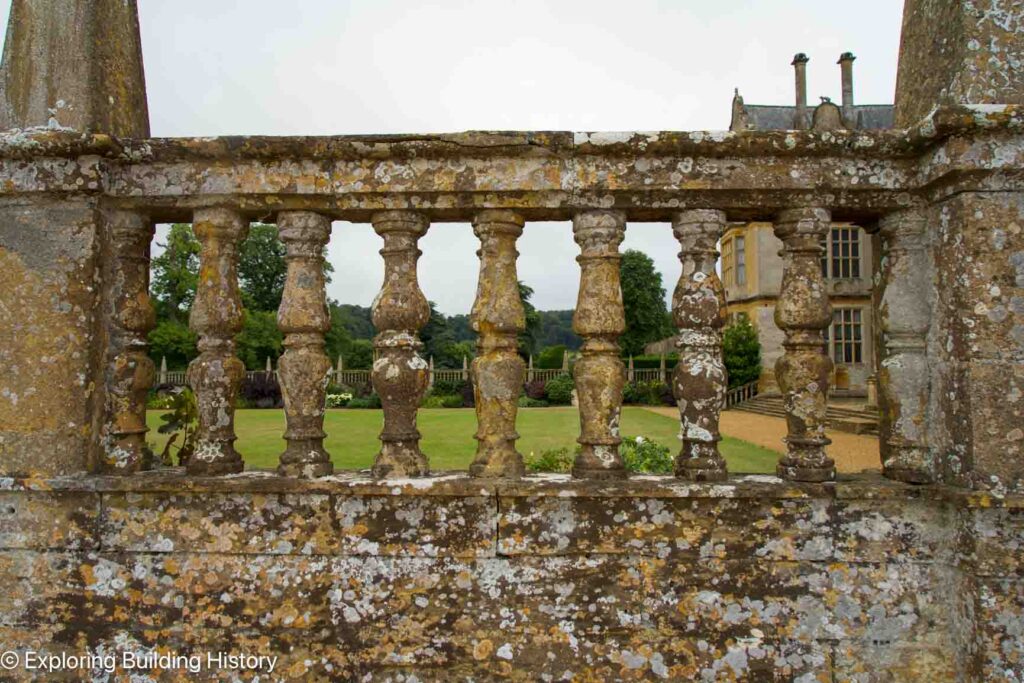
Balustrade section on the north side of the East Court
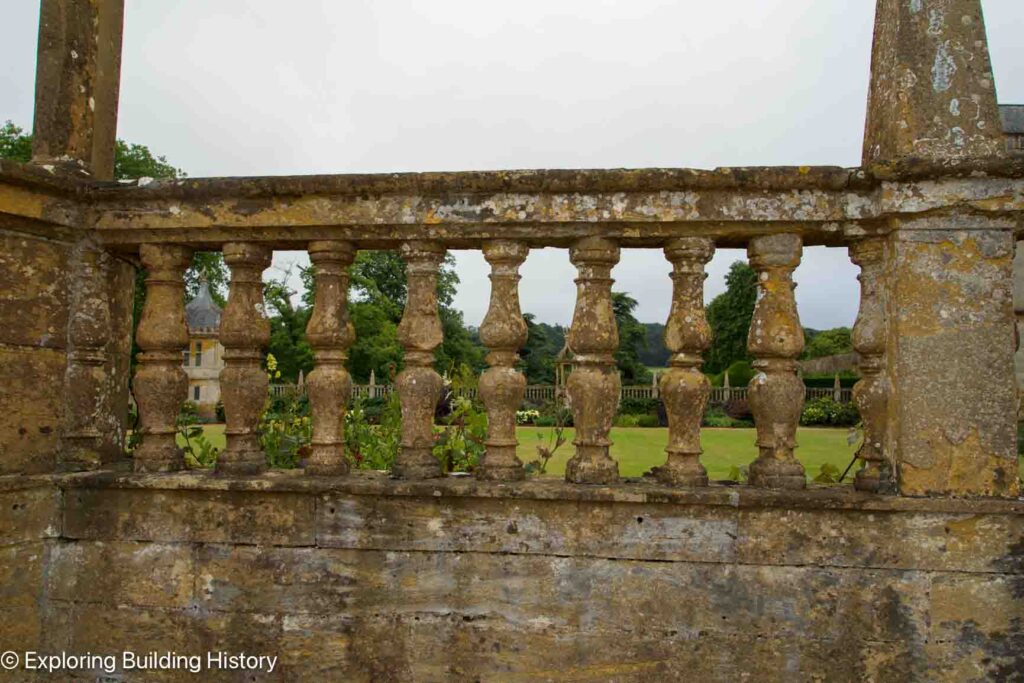
Balustrade section on the north side of the East Court further east.
Is the difference to identify the work of an individual mason for payment reasons?
It may be possible to identify individual masons’ work through the varying baluster styles, particularly the size of the bulb. The overall shape is consistent, but each mason took a slightly different approach. Possibly this was a way for the piece work to be identified when it came to payment. Masons’ marks were employed on individual pieces of worked stone blocks. Perhaps the Montacute masons working on the balustrades didn’t want things too uniform. If the overall effect was pleasing to the eye and the individual work could still be identified, then all objectives were met.
NOTES
[i] Peter Hill, ’51. William Arnold and His Stonemasons’, Somerset and Dorset Notes and Queries (SDNQ), Vol 37, p. 321.
[ii] Nancy Briggs, ‘The Foundation of Wadham College, Oxford’, Oxoniensia, https://www.oxoniensia.org/volumes/1956/briggs.pdf [accessed 21 February 2026], p. 63.