
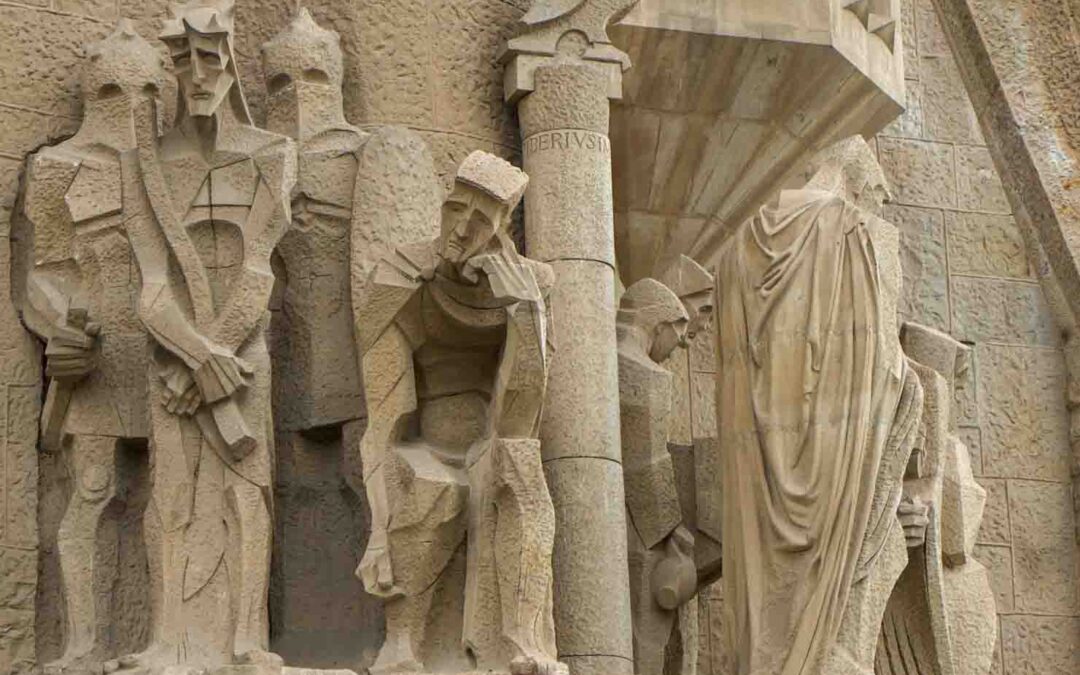
If you visit Barcelona and only see one building, it will almost certainly be the Basilica de la Sagrada Familia.[1] Rising improbably from the Eixample grid, its spires seem to belong to a world between cathedral and coral reef. But for all its fantastical beauty, one of the most striking parts of the basilica is also one of the most deliberately stark: the Passion Facade, facing the setting sun to the west.
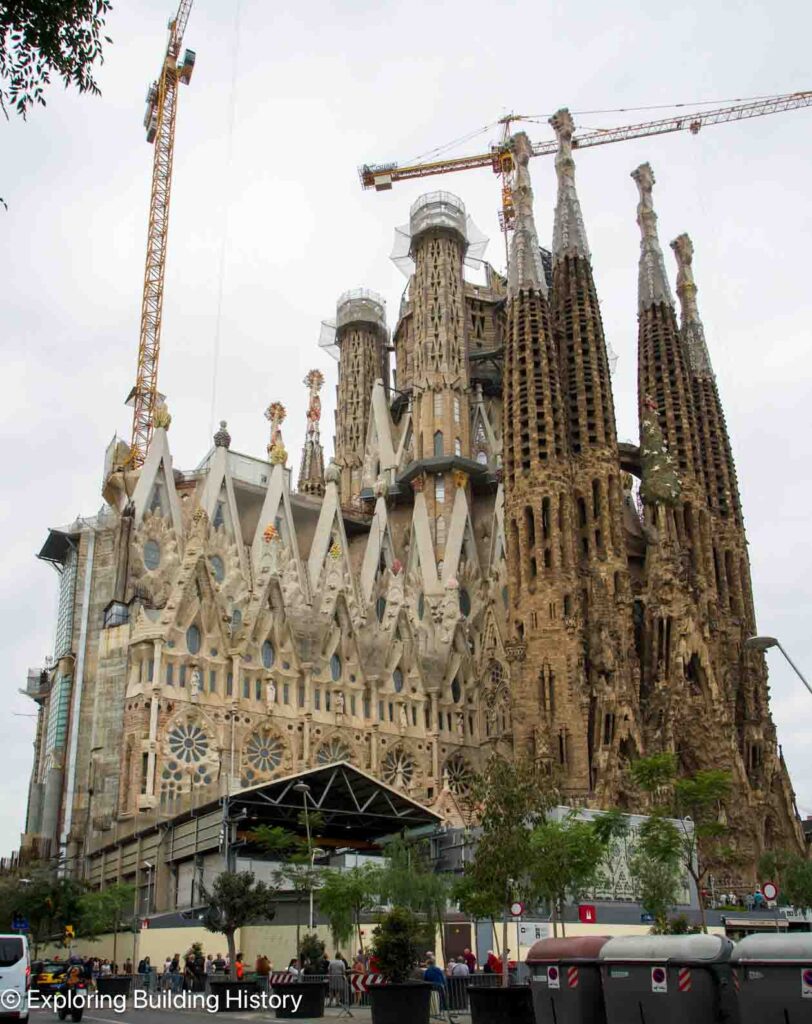
The Sagrada Familia seen from the street, with the ornate Nativity Facade (left) and the angular Passion Facade towers (right). Construction cranes have been a fixture of the Barcelona skyline for over 140 years. I visited in 2019. © Exploring Building History
A Cathedral Unlike Any Other
Construction of the Sagrada Familia began on 19 March 1882, under architect Francisco de Paula del Villar.[2] Within a year, a young Catalan architect named Antoni Gaudi took over the project and transformed it into something that had never been seen before.
Gaudi (1852 to 1926) was the master of Catalan Modernisme, a movement related to Art Nouveau but deeply rooted in the natural world.[3] He studied the geometry of bones, trees, seashells, and rock formations, and wove their structural logic into his buildings. The Sagrada Familia became his life’s work. He gave up all other commissions and lived on site in his final years, supported entirely by private donations. When he was struck by a tram and killed in 1926, less than a quarter of the building was finished.
Construction continued through the twentieth century, interrupted by the Spanish Civil War, during which anarchists burned the crypt and destroyed many of Gaudi’s original plaster models and plans.[4] Using computer modelling from the 1980s onwards, builders were able to interpret and extend Gaudi’s vision. As of 2026, the basilica is nearing structural completion, making it one of the longest-running construction projects in architectural history.
Gaudi’s Vision for the Passion Facade
Gaudi designed three grand facades for the basilica, each representing a different aspect of Christ’s life: the Nativity to the east, the Glory to the south, and the Passion to the west. He conceived the Passion Facade as a deliberate counterpoint to the joyful, richly ornamented Nativity Facade. Where the Nativity teems with life, flowers, animals, and angels, the Passion was intended to convey suffering, austerity, and death.
Gaudi sketched his intentions clearly: bare, bone-like columns; a severe, skeletal composition; an atmosphere of mourning rather than celebration. He did not live to see any of it built. Excavations for the western facade began in 1954, and the first stones were laid in 1956. The four towers were completed in 1976.
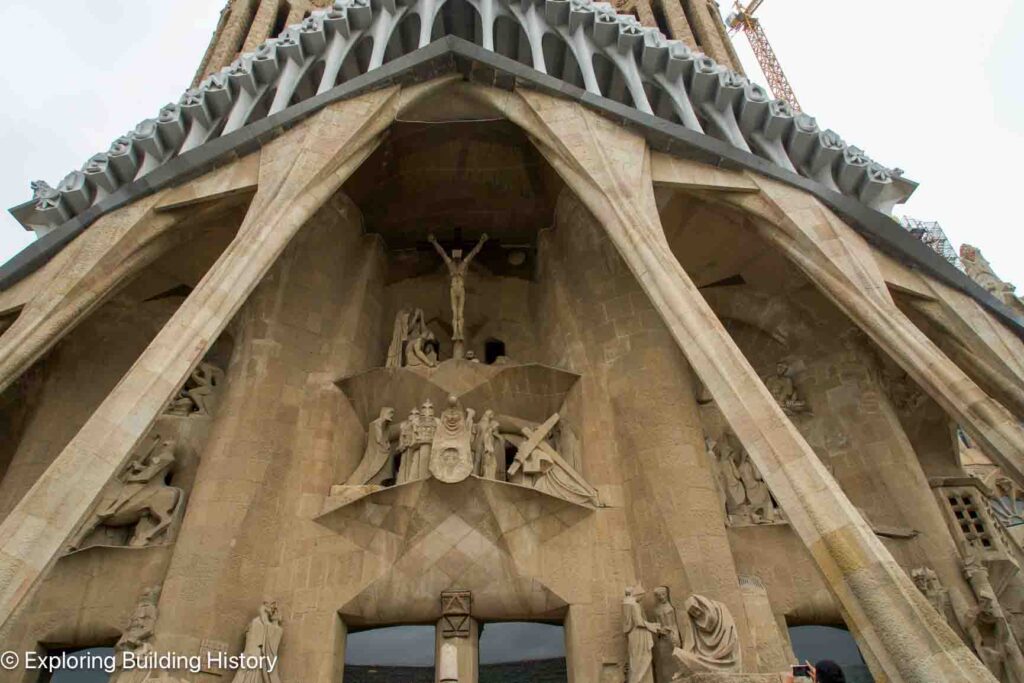
Looking up into the Passion Facade portico. The bone-shaped columns sweep upward to frame the central Crucifixion scene, flanked by Subirachs’ angular sculptural groups on either side. © Exploring Building History
Enter Subirachs: A Bold and Controversial Choice
For the sculptural programme of the Passion Facade, the Sagrada Familia foundation turned to Josep Maria Subirachs (1927 to 2014), a Barcelona-born sculptor and painter known for his angular, expressionist style.[5] He was commissioned in 1986, and he accepted on one firm condition: complete artistic freedom. Out of respect for Gaudi, he said, he would not attempt to imitate him.
Subirachs moved into the Sagrada Familia workshop, immersing himself in the building’s spirit just as Gaudi had done. His first sculpture, the Flagellation of Christ, was set in place in 1987.[6] He continued working on the facade for over two decades, with the final sculptures installed in 2018, bringing more than sixty years of construction on this facade to a close. In 2023, the Government of Catalonia declared Subirachs’ work on the Sagrada Familia a Cultural Asset of National Interest.[7]
The response to his work was immediate and polarising. Many visitors and critics found his gaunt, geometric figures jarring, too different in character from Gaudi’s organic world. Others praised the boldness of the choice, arguing that the stark angularity was exactly right for a facade about agony and death. Standing before the figures today, it is hard not to feel that Subirachs understood his brief.
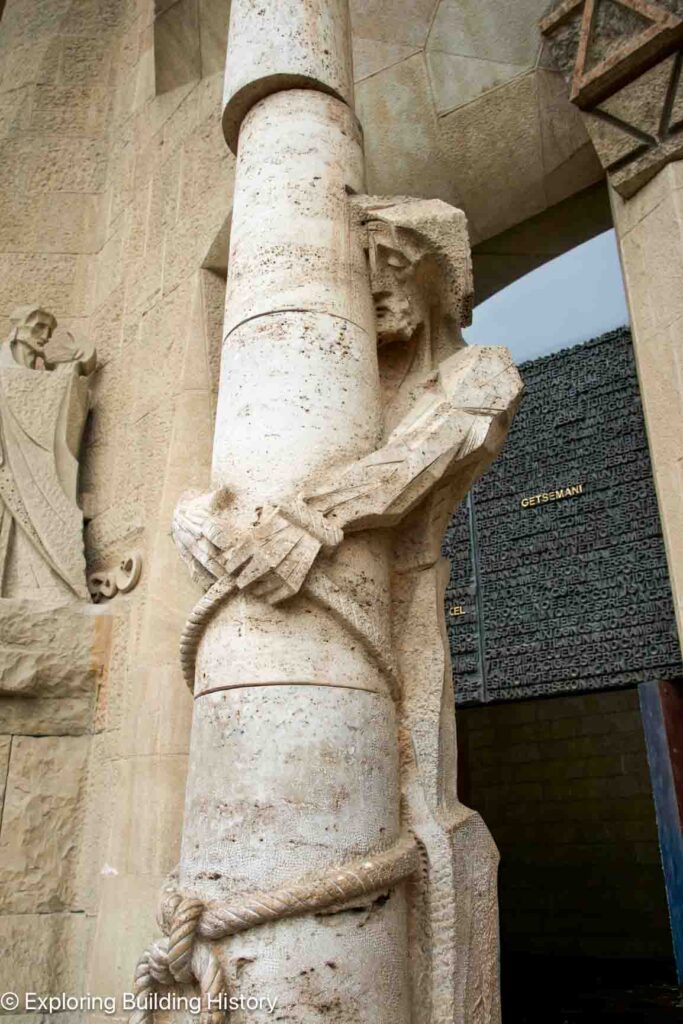
A travertine column of the Passion Facade portico, with a sculpture of Christ bound to the pillar during the Flagellation. The inscription wall reading ‘Getsemani’ is visible behind. © Exploring Building History
The Stone, the Columns, and the Composition
The Passion Facade is built primarily from two materials: travertine limestone, used for the main structural elements and much of the wall surface, and Floresta sandstone, a pale local stone used for many of the sculptural details.[8] The overall effect is deliberately raw and unadorned. Broad stretches of bare stone, with none of the mosaic or ceramic decoration that characterises other parts of the basilica.
The columns of the portico are among the most distinctive elements. Rather than the rounded, tapering forms Gaudi used elsewhere, these are bone-shaped, deeply grooved and almost skeletal in profile, reinforcing the facade’s theme of bodily suffering and mortality. They lean inward at a slight angle, giving the portico a sense of weight and gravity that is quite different from anything else in the building.
Subirachs arranged his sculptures in an S-shaped narrative path that visitors can follow from the bottom left to the top right, tracing the story of the Passion chronologically. The faces are deliberately sharp-edged and emotionally raw. There are no soft curves here. Every line is a hard angle, every expression a mask of grief or fear.
Reading the Facade: A Selection of Scenes
The narrative begins at the lower left with the arrest of Jesus in the Garden of Gethsemane and moves upward through the trial before Pontius Pilate. But the photos start at Ecco Homo. Jesus and Pilate are expressive in their own experiences. The Roman soldiers are faceless, rigid, robotic figures.
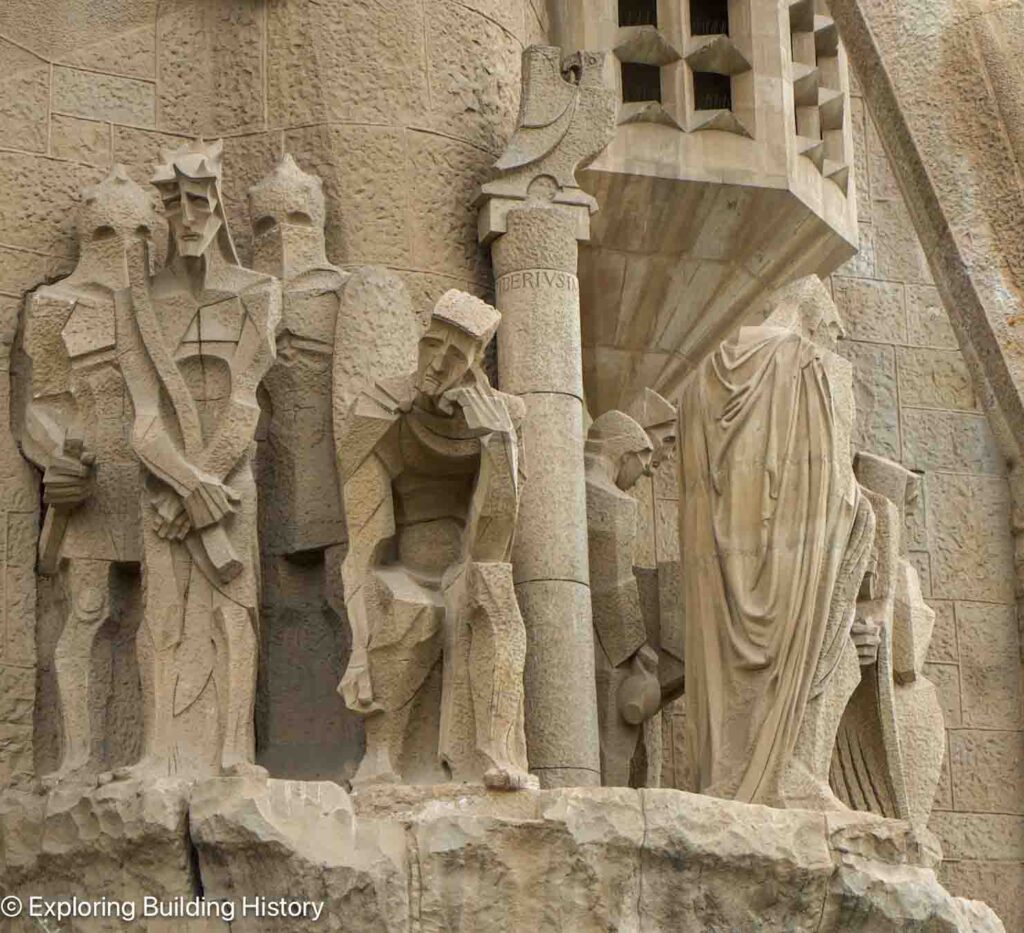
Ecco Homo (“behold the man”): Jesus, is now presented to the crowd by Pontius Pilate with the words Ecco Homo. Jesus has been scourged, bound, beaten, mocked and the crown of thorns placed on his head. Behind him are 2 Roman soldiers and to his left a seated, reflective Pontius Pilate. Below Jesus the stone cracks. Carved in Floresta sandstone. Subirachs gives the soldiers an almost robotic quality, in sharp contrast to the draped figure of Jesus. © Exploring Building History
Higher on the facade, the Via Crucis group shows Christ carrying the cross alongside a remarkable detail: the figure of Saint Veronica, holding out her veil with the imprint of Christ’s face pressed into it. The face on the veil is rendered almost as a flat medallion, a stark and haunting image within an already austere composition.
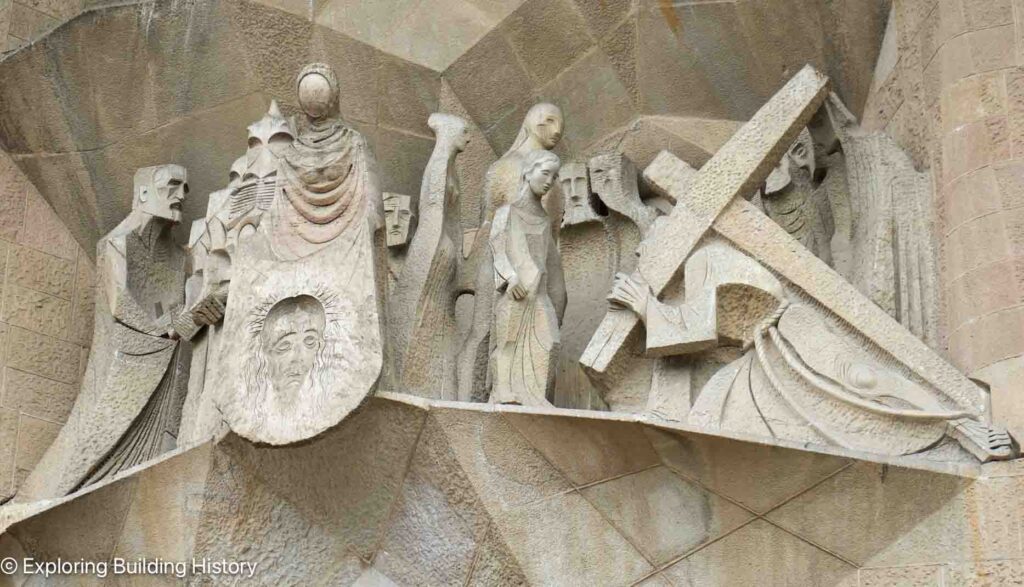
The Via Crucis panel: Jesus meets the women of Jerusalem. Veronica holds the sudarium (the veil bearing Christ’s face) on the left, while Christ carries the cross on the right. The angular, geometric style of Subirachs is strikingly evident in the clustered group of figures. © Exploring Building History
One of the most fascinating details on the entire facade is the magic square that appears beside the scene of the Kiss of Judas. The grid of sixteen numbers is arranged so that every row, column, and diagonal adds up to 33, the traditional age of Christ at the time of his crucifixion.[9] It is Subirachs’ own adaptation of a famous mathematical puzzle, quietly embedded in the stonework for those who know to look for it.
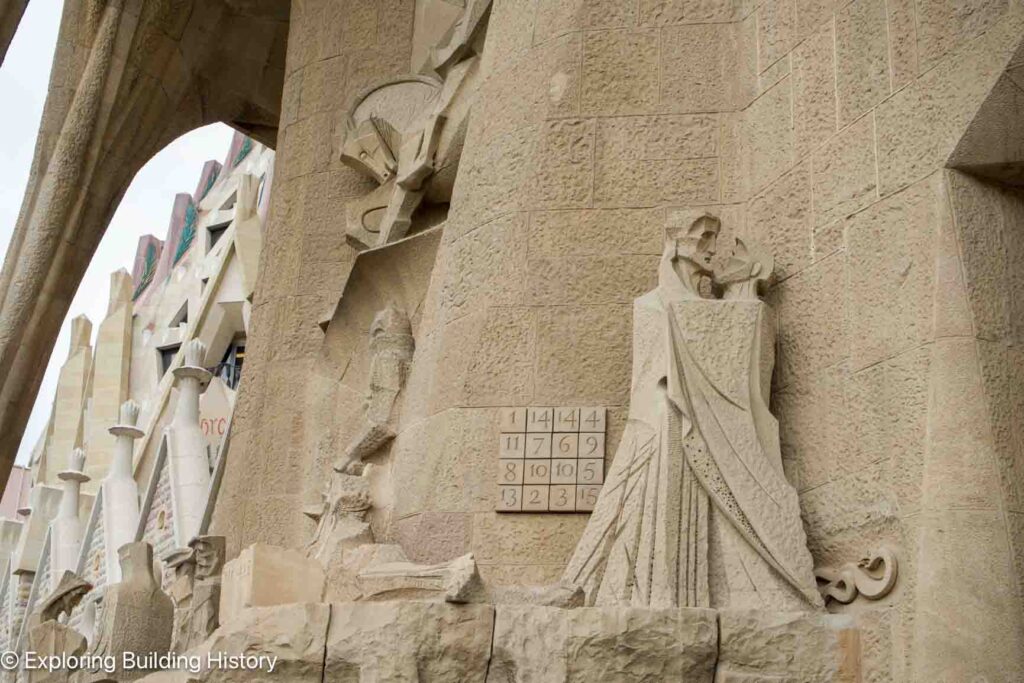
The Kiss of Judas: Notice the snake by Judas’ feet. The magic square by Jesus: every row, column, and diagonal of the 4×4 grid adds up to 33, the age of Christ at the Crucifixion. Subirachs adapted it from Albrecht Durer’s 1514 engraving Melencolia I. © Exploring Building History
Tucked into a niche of the facade, easy to miss, is one of the most symbolically loaded figures on the entire building: a rooster, carved in the stone. This refers to the moment Peter denied Christ three times before the cock crowed, a scene of human weakness and guilt.
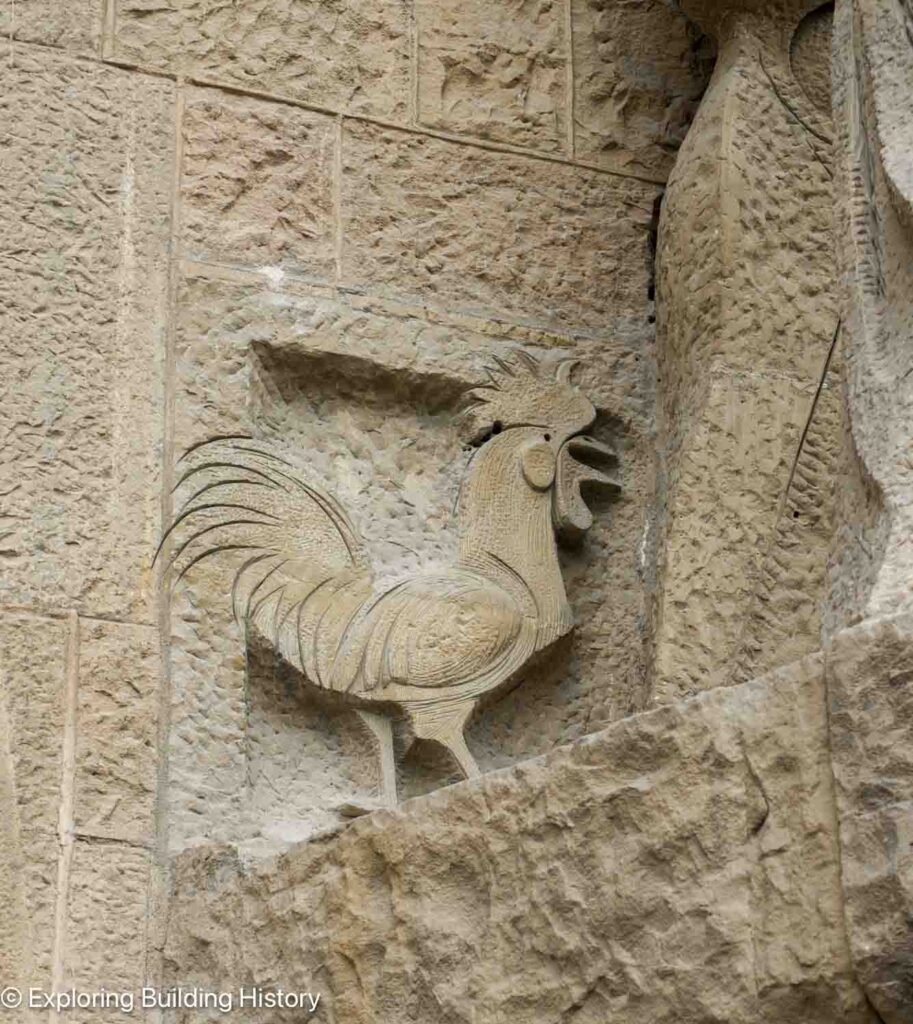
The rooster, carved in stone: a symbol of Peter’s denial of Christ. The detail and texture of the feathers contrasts with the angular geometry that dominates the rest of the facade. © Exploring Building History
At the apex of the narrative, dominating the central archway, the Crucifixion rises above everything else. Christ is shown on a dark cross, his body elongated and taut, while below him the mourning figures of Mary and the other women are grouped in attitudes of grief. A skull at the base of the cross identifies the site as Golgotha, the place of the skull, as named in the Gospels.
The central Crucifixion: Christ on the cross above the mourning women. A skull at the base marks Golgotha. The scale of this group, visible from the street below, makes it the emotional focal point of the entire facade. © Exploring Building History
Alongside the Crucifixion, in a narrow vertical niche between the columns, stands the figure of Longinus, a Roman soldier mounted on horseback. According to the Gospel of John, a soldier pierced Christ’s side with a lance after his death to confirm he had died, and from the wound came blood and water.[10] In later Christian tradition, this soldier was named Longinus and was said to have converted to Christianity as a result. Subirachs renders him and his horse in his characteristic angular, faceted style, the horse’s body a mass of interlocking geometric planes, the rider raising his lance toward the figures above.
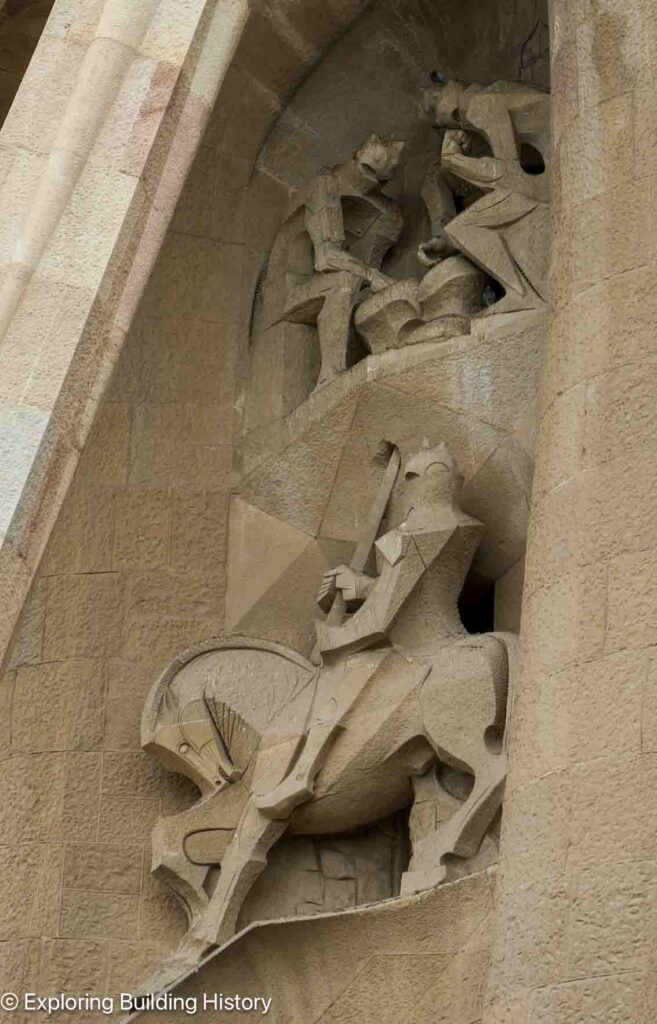
Longinus on horseback: the Roman soldier who, according to tradition, pierced Christ’s side with a lance and later converted to Christianity. Subirachs carves both horse and rider in his signature angular, interlocking geometric style. The scene above depicts Roman soldiers playing dice for Jesus’ garments. © Exploring Building History
The final scenes of the facade move from death toward the beginning of hope. The Descent from the Cross shows the body of Christ being lowered and supported by mourning figures, rendered with tenderness and grief.
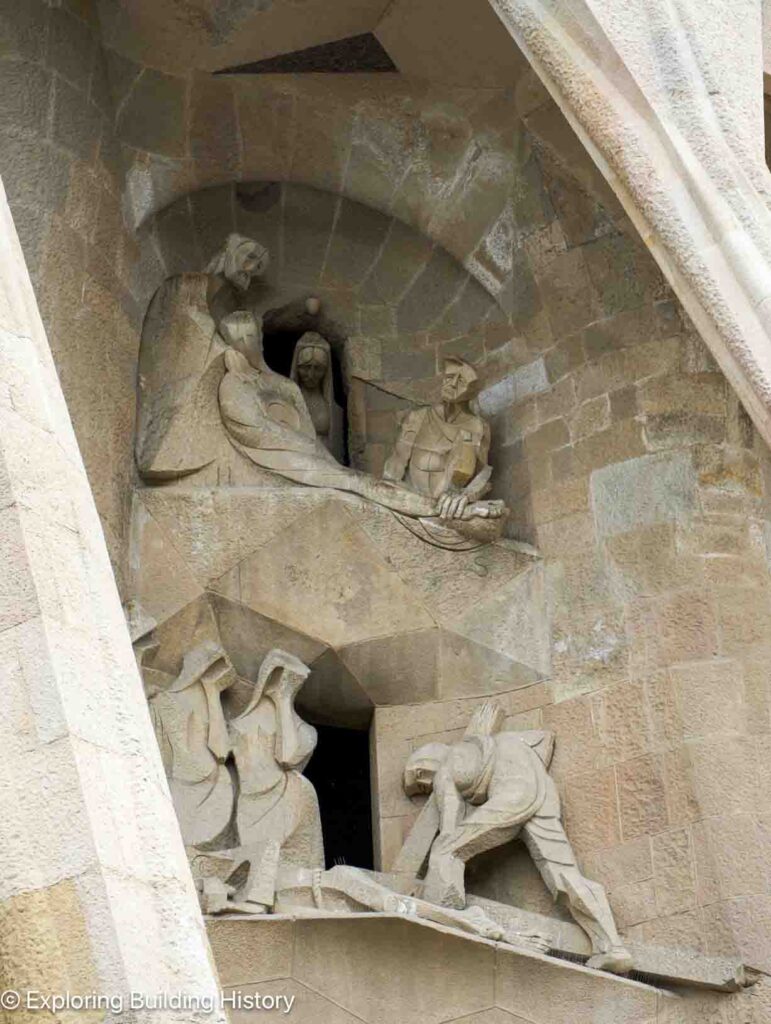
Jesus falls before the 3 Marys: The Virgin Mary, Mary Magdalene & Mary of Clopas) & Simon of Cyrene is commanded to help Jesus with the cross. Above is the descent from the cross. © Exploring Building History
Worth Stopping For
The Passion Facade divides opinion in a way that few works of architecture do, and that may be exactly the point. Gaudi wanted something that would make visitors uncomfortable, that would force them to feel the weight of what the facade represents. Whether or not you find Subirachs’ contribution fully convincing, standing in front of those skeletal columns and searching the crowd of angular faces is an experience that stays with you.
If you are visiting the Sagrada Familia, take your time on the western side before you go in. Walk the S-shaped path with your eye. Look for the cock, the magic square, the face on the veil.
NOTES
[1] The name “Sagrada Familia” means “Holy Family” in Catalan. The basilica is formally known as the Basilica de la Sagrada Familia. Pope Benedict XVI consecrated it as a minor basilica in November 2010.
[2] Del Villar was commissioned by the Spiritual Association of Devotees of Saint Joseph, a lay organisation that had purchased land in what was then the eastern outskirts of Barcelona. He resigned after disagreements over costs and design direction.
[3] Gaudi was born in Reus, Catalonia, on 25 June 1852. He died on 10 June 1926, three days after being struck by a tram on the Gran Via de les Corts Catalanes. He had been unrecognised due to his plain appearance and was initially taken to a paupers’ hospital. He is buried in the crypt of the Sagrada Familia.
[4] In July 1936, members of the anarchist federation FAI set fire to the crypt and broke into the workshop, destroying plaster models, drawings, and photographs. Architects and researchers subsequently spent years reconstructing Gaudi’s intentions from surviving fragments, notes, and photographic records.
[5] Subirachs was born in Barcelona on 11 March 1927 and died on 7 April 2014. He was widely known for large-scale public sculptures across Catalonia and internationally. He had initially studied in Paris, where he came into contact with avant-garde artists including Henry Moore.
[6] The Flagellation depicts the moment Christ was bound to a column and scourged by Roman soldiers before his crucifixion. Subirachs’ version shows the figure pressed against the column with his hands bound above him.
[7] The designation Bé Cultural d’Interes Nacional (Cultural Asset of National Interest) is the highest level of heritage protection in Catalonia. The declaration covers all of Subirachs’ sculptural work on the Sagrada Familia.
[8] Travertine is a form of limestone deposited by mineral springs and is closely associated with Italian and Spanish architecture. The travertine used on the Passion Facade was quarried from deposits in the Tarragona region of Catalonia.
[9] The magic square is Subirachs’ adaptation of the magic square that appears in the engraving Melencolia I by Albrecht Durer (1514), in which every row, column, and diagonal adds to 34. Subirachs altered two numbers in the grid so that the constant becomes 33, the traditional age of Christ at the time of his crucifixion.
[10] The account of the soldier piercing Christ’s side appears in John 19:34. The name Longinus does not appear in the canonical Gospels but derives from later apocryphal texts, including the Acts of Pilate. Longinus is venerated as a saint in both the Catholic and Orthodox churches.
SOURCES
‘AD Classics, La Sagrada Familia / Antoni Gaudi’, ArchDaily, https://www.archdaily.com/438992/ad-classics-la-sagrada-familia-antoni-gaudi[accessed 29 March 2026]
Aleteia: ‘Exploring Subirachs’ bold sculptures in the Sagrada Familia’, Ateleia, https://aleteia.org/2023/11/08/exploring-subirachs-bold-sculptures-in-barcelonas-sagrada-familia/ [accessed 29 March 2026]
Catalan News: ‘Sagrada Familia’s main sculptor Josep Maria Subirachs has died aged 87’, Catalan News, April 9, 2014, https://www.catalannews.com/culture/item/sagrada-familia-s-main-sculptor-josep-maria-subirachs-has-died-aged-87 [accessed 29 March 2026]
Collins, George, R., ‘Antoni Gaudi’, Britannica, https://www.britannica.com/biography/Antoni-Gaudi [accessed 29 March 2026]
‘History of the Basilica’, Basilica Sagrada Familia, https://sagradafamilia.org/en/history-of-the-temple [accessed 29 March 2026]
‘Josep Maria Subirachs’, Fundacio Sunol, https://www.fundaciosunol.org/en/artista/subirachs-josep-maria/ [accessed 29 March 2026]
Middleton, James, ‘Sagrada Familia’, Britannica, https://www.britannica.com/topic/Sagrada-Familia [accessed 29 March 2026]
‘Passion façade: a journey through Jesus final days’, Basilica Sagrada Familia, https://blog.sagradafamilia.org/en/meaning-passion-facade-sagrada-familia/ [accessed 29 March 2026]
‘Subirachs’ work declared Cultural Asset of National Interest’, Basilica Sagrada Familia, https://sagradafamilia.org/en/detalle/-/asset_publisher/7JWibz9G2KUY/content/l-obra-de-subirachs-a-la-sagrada-familia-declarada-be-cultural-d-interes-nacional [accessed 29 March 2026]
‘The Facade of the Passion, History and Symbolism of the most terrifying façade of the Sagrada Familia’, Barbany Artesans, https://www.granitsbarbany.com/en/the-facade-of-the-passion-history-and-symbolism-of-the-most-terrifying-facade-of-the-sagrada-familia/[accessed 29 March 2026]
UNESCO World Heritage Centre: ‘Works of Antoni Gaudi’, UNESCO World Heritage Centre, https://whc.unesco.org/en/list/320/ [accessed 29 March 2026]