
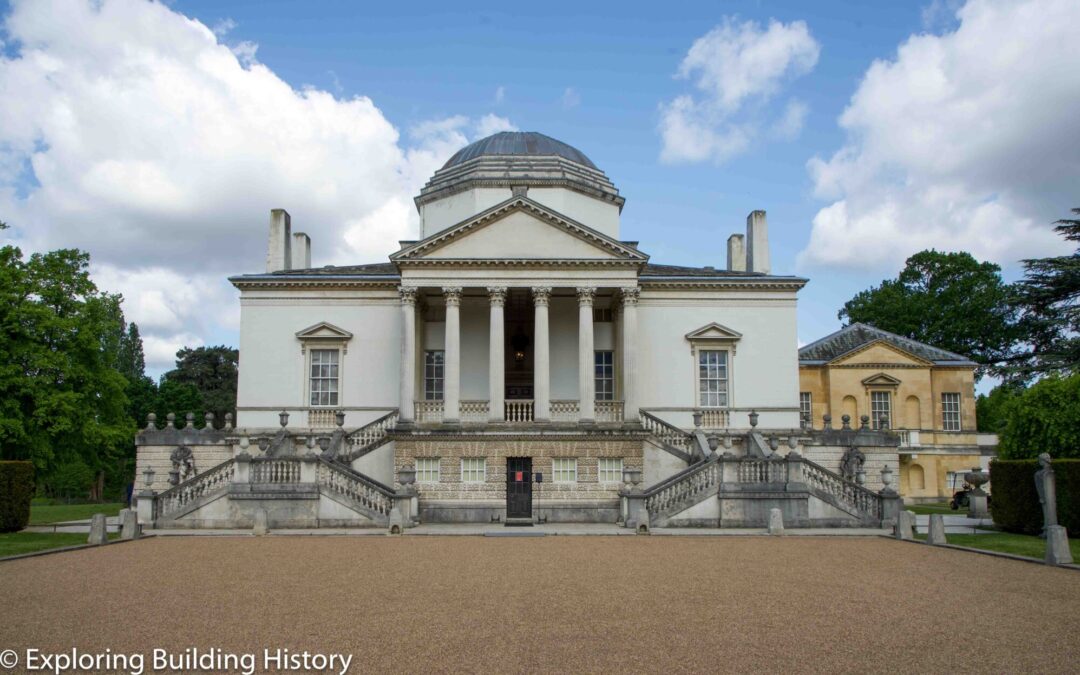
Few buildings in England can claim to have fundamentally altered the course of the nation’s architectural history. Chiswick House, the compact neo-Palladian villa in west London designed and built by Richard Boyle, 3rd Earl of Burlington, between 1726 and 1729, is one of them.[i] More than a private retreat for the display of art and the entertainment of friends, it was a polemical statement — a declaration, rendered in Portland stone and Roman proportion, that English architecture should return to the classical principles embodied by Andrea Palladio and, before him, by the architects of ancient Rome.
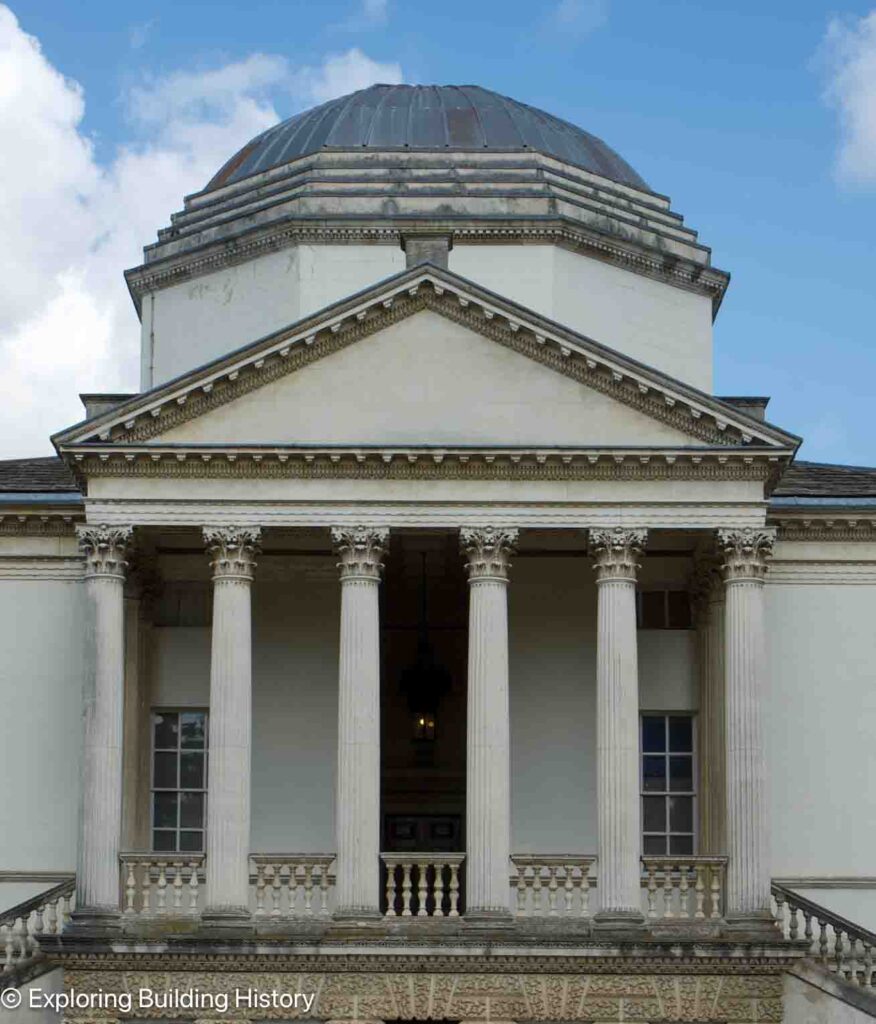
The hexastyle portico draws on classical temple design and provides a grand entrance to the villa.
Lord Burlington and the Palladian Cause
By the early eighteenth century, English architecture was dominated by the exuberant Baroque of Vanbrugh, Hawksmoor, and their followers. Richard Boyle, who inherited the earldom of Burlington at the age of nine,[ii] was determined to change that. His Grand Tours of Italy in 1714 and 1719 brought him into direct contact with the buildings of Palladio in the Veneto and the ruins of classical Rome, and he returned to England with a formidable collection of Palladio’s original drawings, supplemented by those of Inigo Jones — the architect who had first introduced Palladian ideas to England a century earlier.
Burlington was not merely an admirer; he was an evangelist. He sponsored the publication of an English translation of Palladio’s I Quattro Libri dell’Architettura and financed the publication of drawings by Inigo Jones and Palladio.[iii]He gathered around him a circle of like-minded architects, artists, and writers — among them William Kent, Colen Campbell, and Alexander Pope — who shared his conviction that the Baroque had become an exercise in theatrical excess, and that architecture should aspire to the rational beauty and harmonic proportion of the ancients.

Palladio & Jones both commemorated with statues at the front of Chiswick House
Chiswick was essentially a house for entertainment and an architectural showcase. It was a villa on the outskirts of London to the west, and not in the remote centre of an agricultural estate like the Palladian villas of the Veneto in Italy. It was visible and accessible. Lord Burlington didn’t even sleep in it. He slept in what was left of the Jacobean house, next door.[iv]
The Villa: Proportion, Geometry, and Roman Precedent
Chiswick House is often described as being modelled on Palladio’s Villa Capra (La Rotonda) near Vicenza, but the relationship is more nuanced than simple imitation. Burlington had been offered a design by Colen Campbell closely based on the Villa Capra; he rejected it (Campbell’s design was later used at Mereworth Castle in Kent). What Burlington created instead was something more ambitious: an attempt, as the architectural historian Richard Hewlings has argued, to recreate a Roman villa rather than produce a Renaissance pastiche.[v]
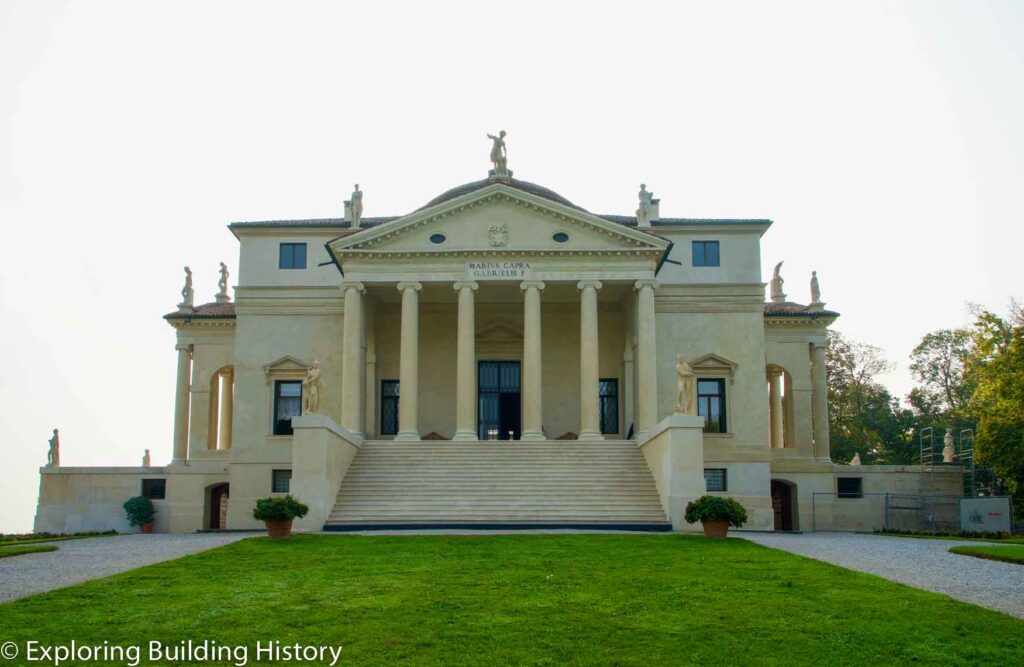
The Villa Capra (Rotunda). At Chiswick there is only one portico, rather than the four at Villa Capra.
The mathematics of the building are characteristically rigorous. The villa is a half-cube: seventy feet on each side, thirty-five feet high. The distance from the apex of the dome to the base of the cellar is seventy feet, so the entire structure fits within a perfect, invisible cube.[vi] This is architecture as geometry — a building whose beauty derives not from ornamental display but from the harmony of its proportions.
The projecting hexastyle portico, with its finely carved Corinthian capitals by the mason John Boson, draws directly from the Temple of Castor and Pollux in Rome. The rusticated vermiculation and inset doorway are derived from the base of Trajan’s Column.[vii] Every element was chosen with scholarly precision, each detail a reference to a specific Roman source. This was architecture as argument: Burlington was demonstrating, in built form, how England’s buildings should look.
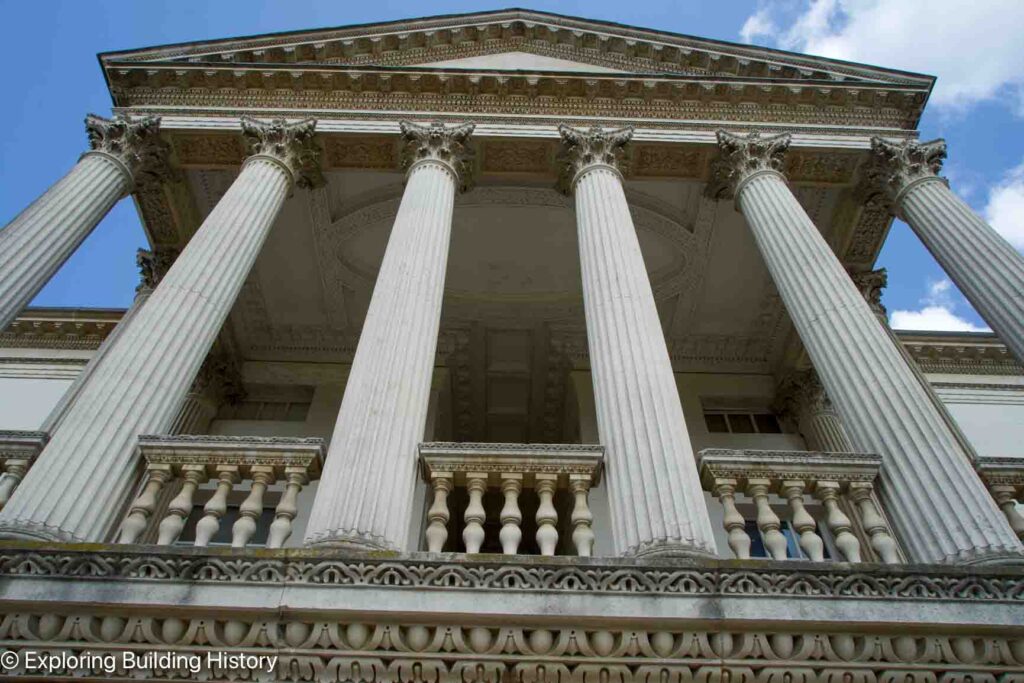
Corinthian Columns of Chiswick House
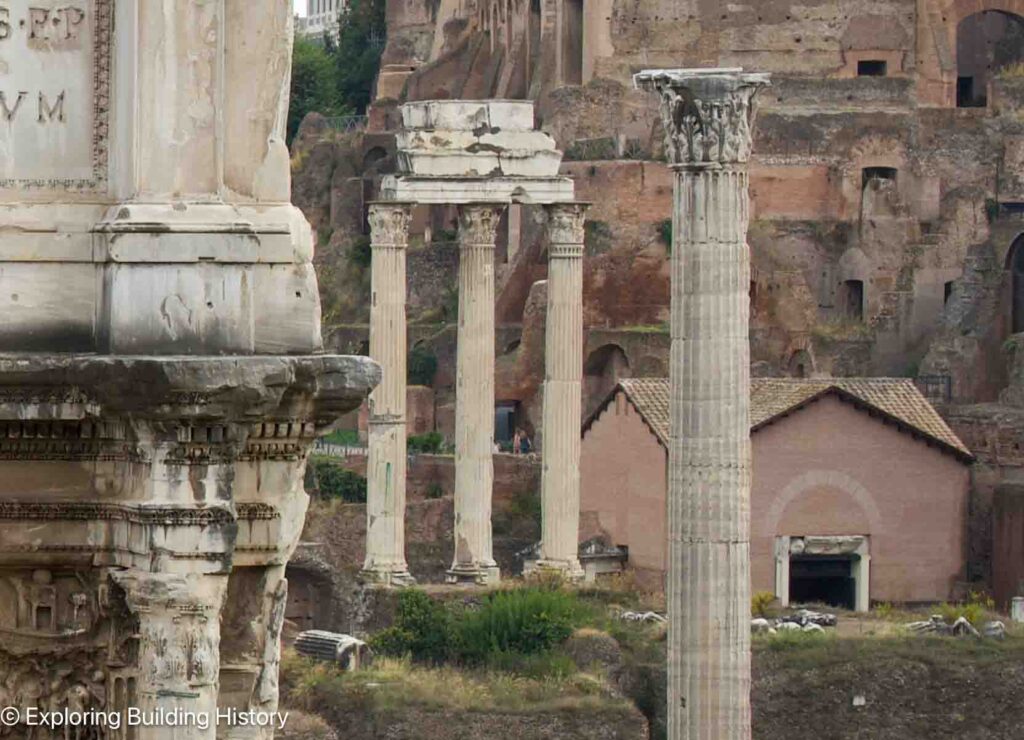
Trio of columns – remains of the Temple of Castor & Pollux, Forum, Rome
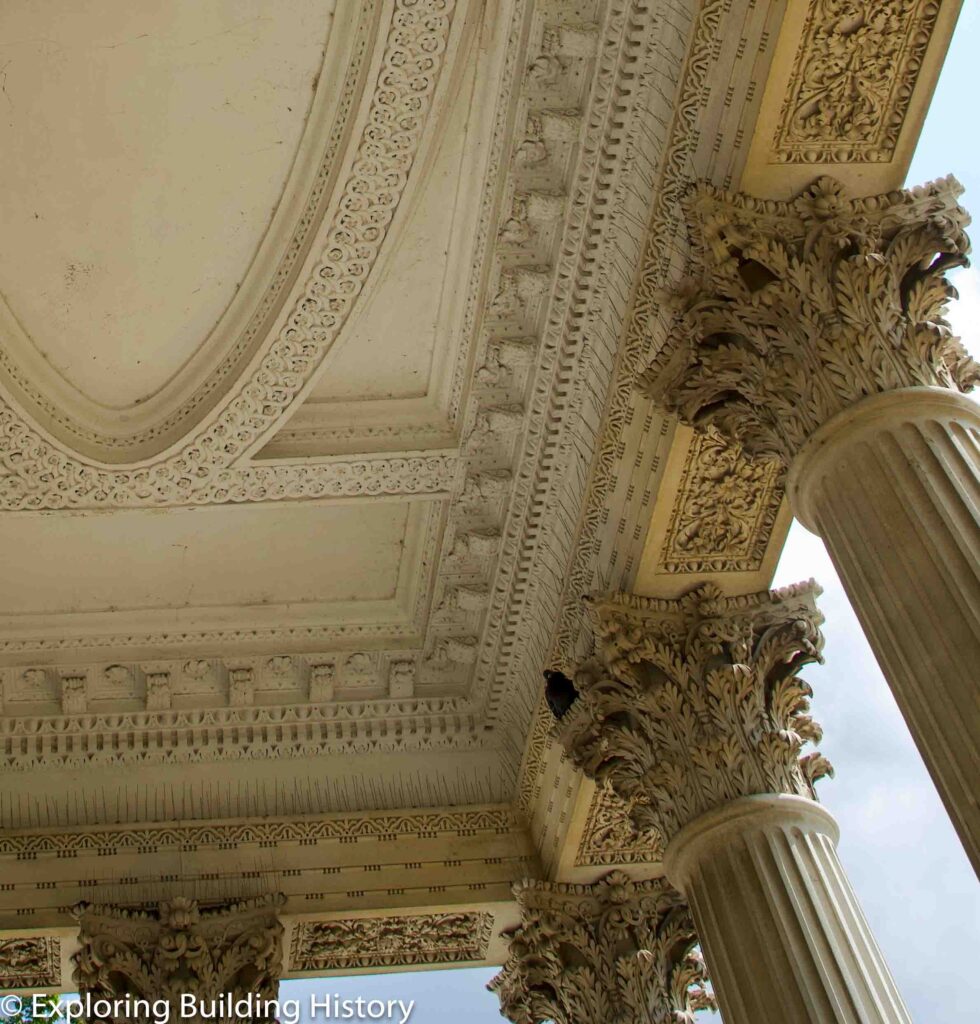
Capitals of the Corinthian Columns of Chiswick House
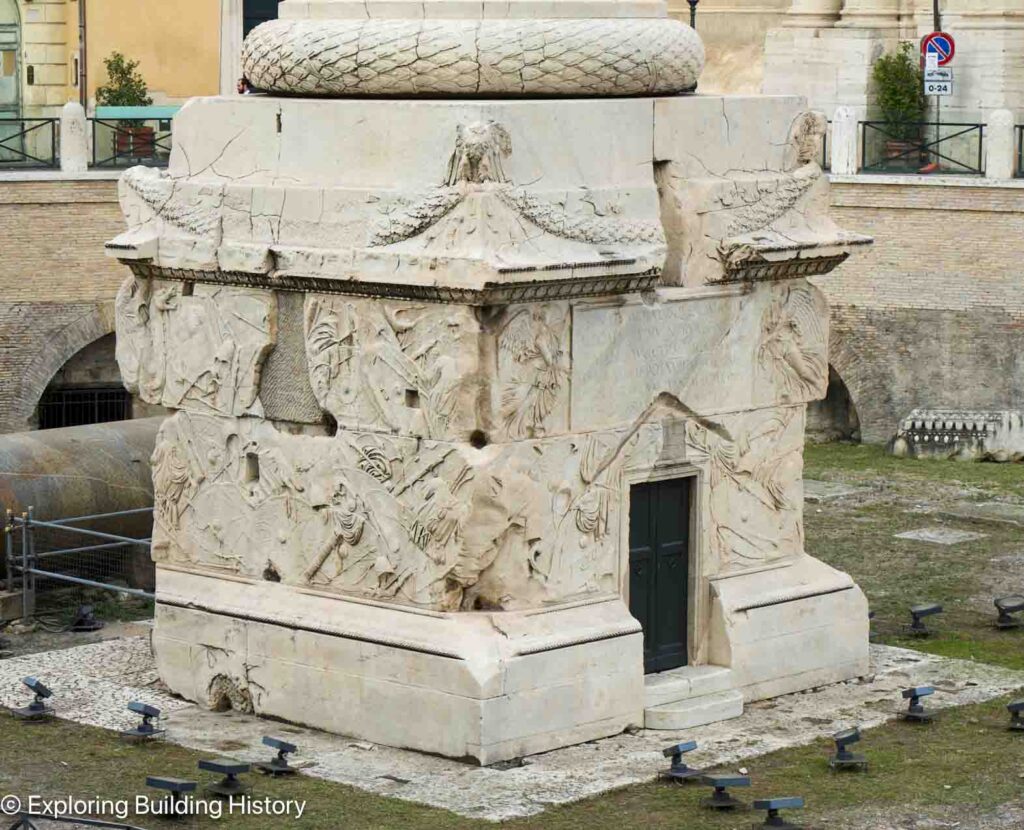
Base of Trajan’s Column, Rome. Chiswick replicates the idea of the doorway into the rusticated ground level.
Interior
The interior incorporates designs by William Kent and complements the classical rigour of the exterior with richly decorated rooms that served as a setting for Burlington’s art collection.[viii] Kent’s painted ceilings, gilded ornament, and carefully considered colour schemes created a sequence of spaces that moved from the grandeur of the central octagonal saloon to more intimate cabinets and galleries. The plan, with rooms radiating from the central domed hall, owed as much to the Roman baths as to Palladio.

The Blue Room at Chiswick House. Designed by William Kent. One of the portraits above the doorways is that of Inigo Jones.

Blue silk velvet wall hangings and an elaborate painted and gilded ceiling.
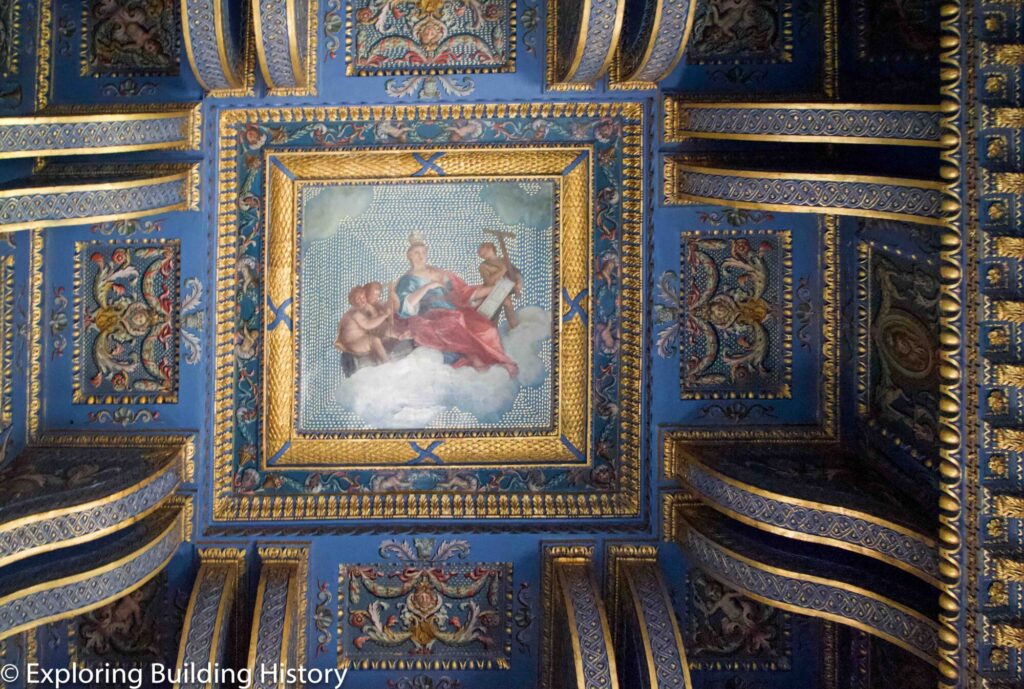
The allegorical figure of Architecture in the centre of the ceiling in the Blue Room.

William Kent also designed furniture. A gilt, blue silk velvet chair designed by Kent to furnish the Blue Room.
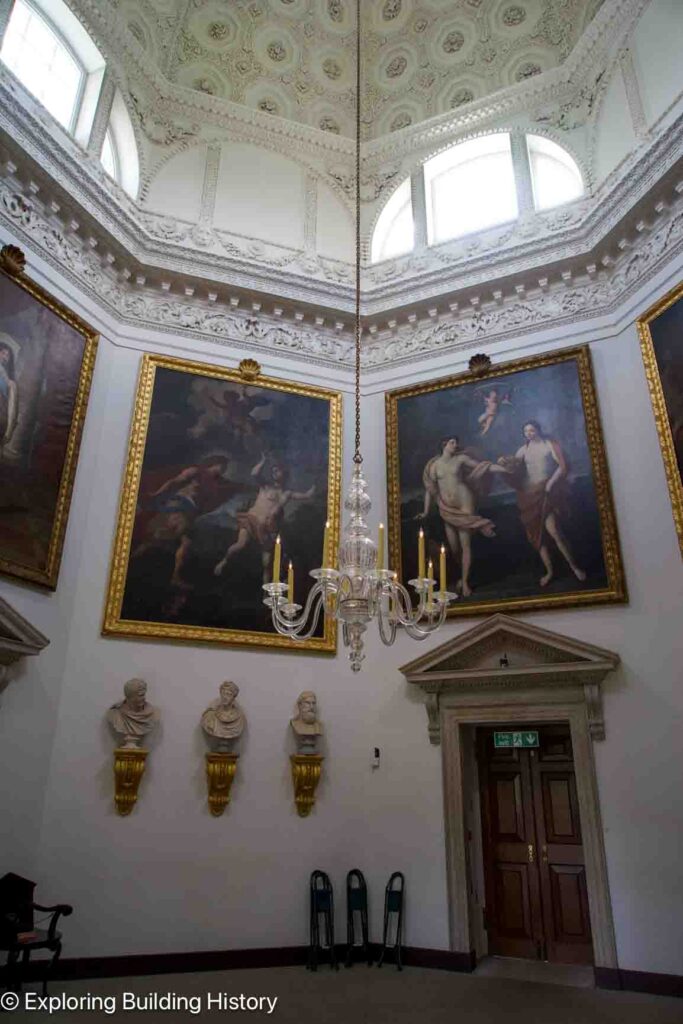
Central Octagon Saloon at Chiswick House.
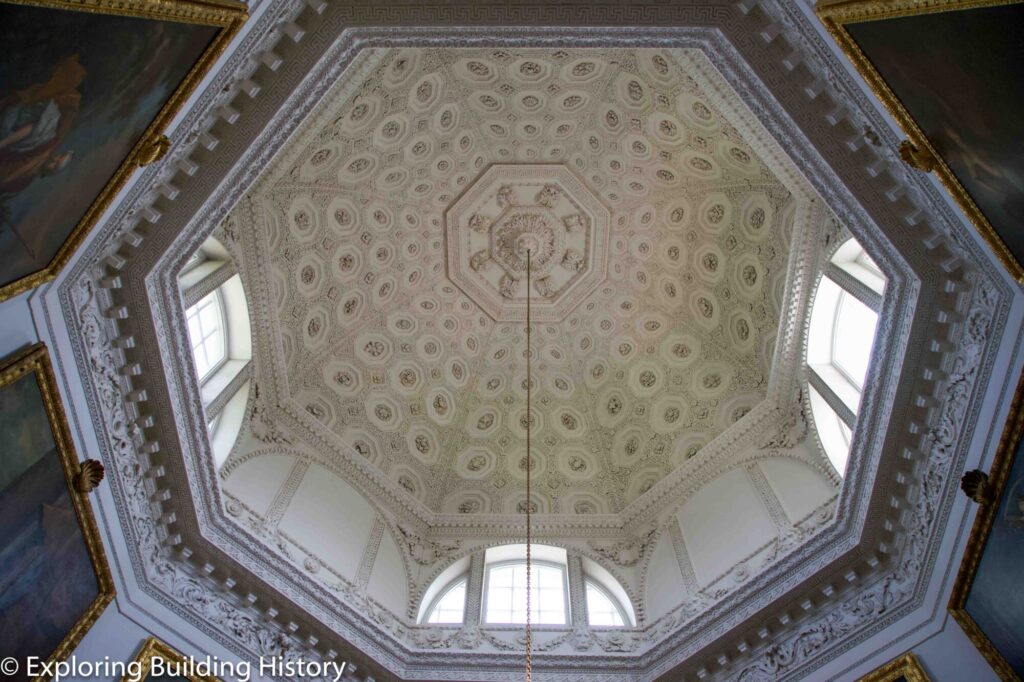
Interior of the Dome of the Central Octagon Saloon of Chiswick House with Diocletian Windows. The term comes from the design of the segmental openings at the Baths of Diocletian in Rome (AD 302).
The Gardens: Birthplace of the English Landscape Movement
If Chiswick House altered the trajectory of English architecture, its gardens did something equally remarkable for landscape design. From the 1720s, Burlington and Kent began experimenting with a new approach to the garden, one that moved away from the rigid geometry of Continental formal gardens towards something more naturalistic, more painterly, and more deeply rooted in classical literary ideals.
The gardens at Chiswick drew inspiration from the descriptions of ancient Roman gardens, particularly the Emperor Hadrian’s Villa Adriana at Tivoli. Kent and Burlington incorporated features that would become hallmarks of the English landscape garden: the ha-ha (a sunken boundary that removed visible barriers between garden and parkland), classical garden buildings and temples, carefully placed statuary, serpentine water features, and groves of trees arranged to create natural-seeming but artfully composed views.[ix]
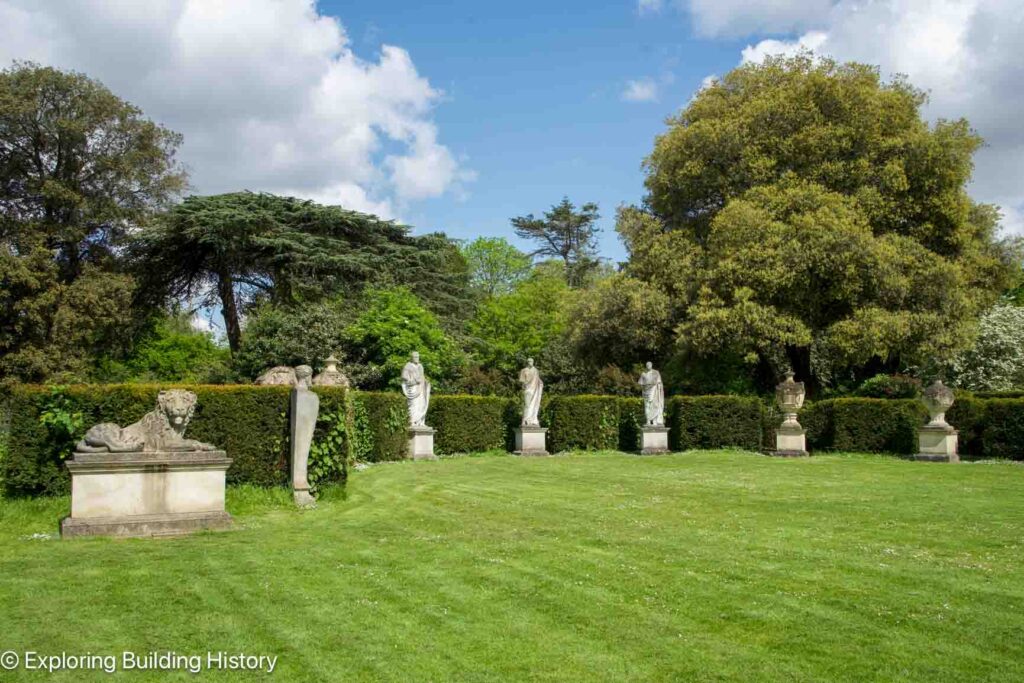
Garden Statuary
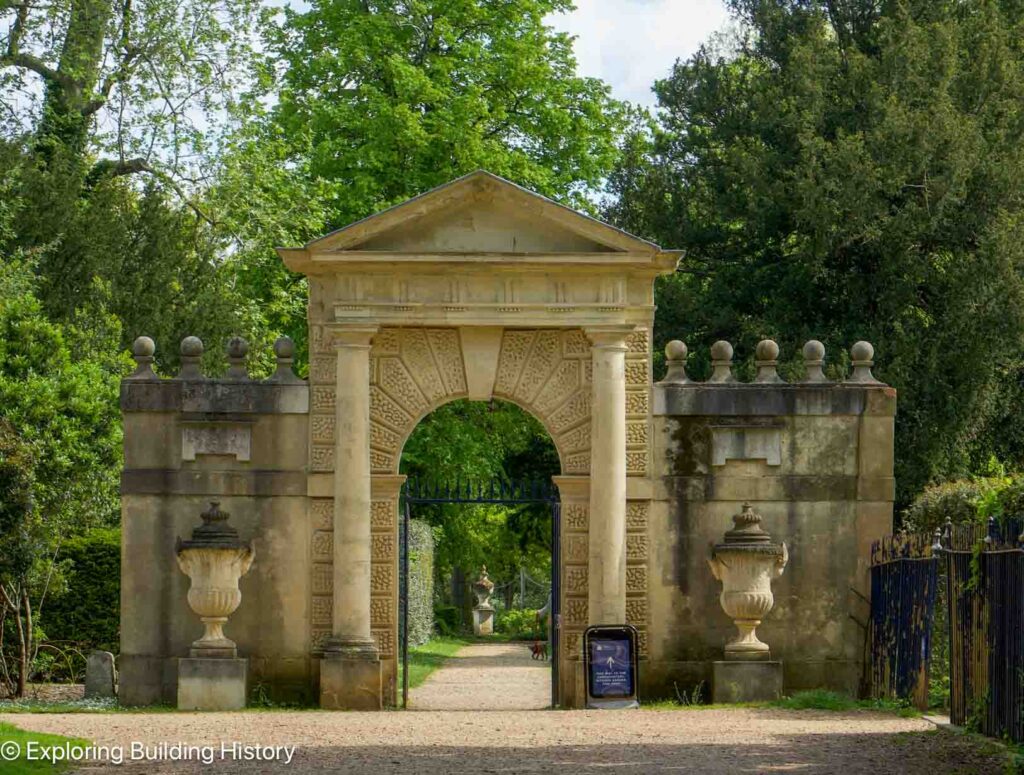
Classical Arch

Temple & Obelisk
These innovations were profoundly influential. The ideas developed at Chiswick by Kent would later be expanded by Lancelot ‘Capability’ Brown and Humphry Repton into the landscape park tradition that became England’s most significant contribution to European garden design. The Chiswick gardens can justly claim to be the birthplace of the English landscape movement.
A Legacy Beyond Chiswick
The influence of Chiswick House extended far beyond its west London setting. Burlington’s neo-Palladian style became the dominant architectural language of the English ruling class for much of the eighteenth century. Country houses across England adopted its principles of symmetry, classical proportion, and restrained ornament. Holkham Hall in Norfolk, designed by Kent and Burlington’s circle, is perhaps the grandest realisation of these ideas,[x] but the influence can be traced in houses, public buildings, and even terraced streets throughout the Georgian period.

Holkham Hall in Norfolk
For Burlington and his followers, Palladianism carried ideological weight. It signalled a connection between the perceived virtues and political systems of ancient Rome and the ambitions of the burgeoning British nation. To build in the Palladian manner was to assert a particular vision of civilisation: rational, orderly, rooted in classical learning, and distinctly opposed to the absolutist grandeur associated with the Baroque courts of Continental Europe.[xi]
The reach of Chiswick’s influence was not confined to England. The neo-Palladian movement crossed the Atlantic, shaping the architecture of colonial and early republican America. Thomas Jefferson, himself a devoted student of Palladio, drew on the same sources that Burlington had championed. The classical porticos and symmetrical plans of American civic architecture owe a debt, traceable through Burlington, to the ideas first given built expression at Chiswick.[xii]
SUMMARY
Chiswick House “whilst a small building” has had a profound and lasting influence. In its precise geometry, its scholarly classicism, it embodies the moment when English architecture decisively turned towards Palladio and the ancient world — a turn whose consequences shaped the built environment of Britain and beyond for the century that followed. It remains, nearly three hundred years after its completion, one of the most intellectually coherent and architecturally significant buildings in England.
NOTES
[i]English Heritage, ‘History of Chiswick House and Gardens’. https://www.english-heritage.org.uk/visit/places/chiswick-house/history/[accessed 1 March 2026].
[ii]Encyclopaedia Britannica, ‘Richard Boyle, 3rd Earl of Burlington’. https://www.britannica.com/biography/Richard-Boyle-3rd-earl-of-Burlington [accessed 1 March 2026].
[iii]Victoria and Albert Museum, ‘Palladianism: An Introduction’. https://www.vam.ac.uk/articles/palladianism-an-introduction [accessed 1 March 2026].
[iv] Clive Aslet, The Story of the Country House (New Haven & London: Yale University Press, 2021), pp. 129-130.
[v]Richard Hewlings, ‘Chiswick House and Gardens: Appearance and Meaning’, in Lord Burlington: Architecture, Art and Life (London: The Hambledon Press, 1995), pp. 1-149.
[vi]Encyclopaedia Britannica, ‘Chiswick House’. https://www.britannica.com/place/Chiswick-House; see also English Heritage, ‘History of Chiswick House and Gardens’. [accessed 1 March 2026].
[vii]Bluffton University, ‘Images of Chiswick House by Lord Burlington’. https://homepages.bluffton.edu/~sullivanm/england/london/chiswick/burlington.html; see also English Heritage, ‘History of Chiswick House and Gardens’. [accessed 1 March 2026].
[viii]Victoria and Albert Museum, ‘William Kent: Designing Georgian Britain’. https://www.vam.ac.uk/articles/william-kent-designing-georgian-britain [accessed 1 March 2026]
[ix]Chiswick House & Gardens Trust, ‘Design and Nature’. https://chiswickhouseandgardens.org.uk/our-story/design-nature/ [accessed 1 March 2026].
[x]Holkham Estate, ‘History of Holkham Hall & Estate’. https://www.holkham.co.uk/about-us/our-history/ [accessed 1 March 2026].
[xi]Victoria and Albert Museum, ‘Palladianism: An Introduction’. https://www.vam.ac.uk/articles/palladianism-an-introduction [accessed 1 March 2026].
[xii]Britannica, ‘Chiswick House’. https://www.britannica.com/place/Chiswick-House [accessed 1 March 2026].
SOURCES
Aslet, Clive, The Story of the Country House (New Haven & London: Yale University Press, 2021)
Bluffton University, ‘Images of Chiswick House by Lord Burlington’, https://homepages.bluffton.edu/~sullivanm/england/london/chiswick/burlington.html [accessed 1 March 2026]
Chiswick House & Gardens Trust, ‘Design and Nature’. https://chiswickhouseandgardens.org.uk/our-story/design-nature/[accessed 1 March 2026]
Encyclopaedia Britannica, ‘Chiswick House’. https://www.britannica.com/place/Chiswick-House [accessed 1 March 2026]
Encyclopaedia Britannica, ‘Richard Boyle, 3rd Earl of Burlington’. https://www.britannica.com/biography/Richard-Boyle-3rd-earl-of-Burlington[accessed 1 March 2026]
English Heritage, ‘History of Chiswick House and Gardens’. https://www.english-heritage.org.uk/visit/places/chiswick-house/history/ [accessed 1 March 2026]
Hewlings, Richard, ‘Chiswick House and Gardens: Appearance and Meaning’, in Lord Burlington: Architecture, Art and Life (London: The Hambledon Press, 1995)
Holkham Estate, ‘History of Holkham Hall & Estate’. https://www.holkham.co.uk/about-us/our-history/ [accessed 1 March 2026]
Victoria and Albert Museum, ‘Palladianism: An Introduction’. https://www.vam.ac.uk/articles/palladianism-an-introduction[accessed 1 March 2026]
Victoria and Albert Museum, ‘William Kent: Designing Georgian Britain’. https://www.vam.ac.uk/articles/william-kent-designing-georgian-britain [accessed 1 March 2026]